By Jason Hauer | CEO & Founder, HauerX Holdings
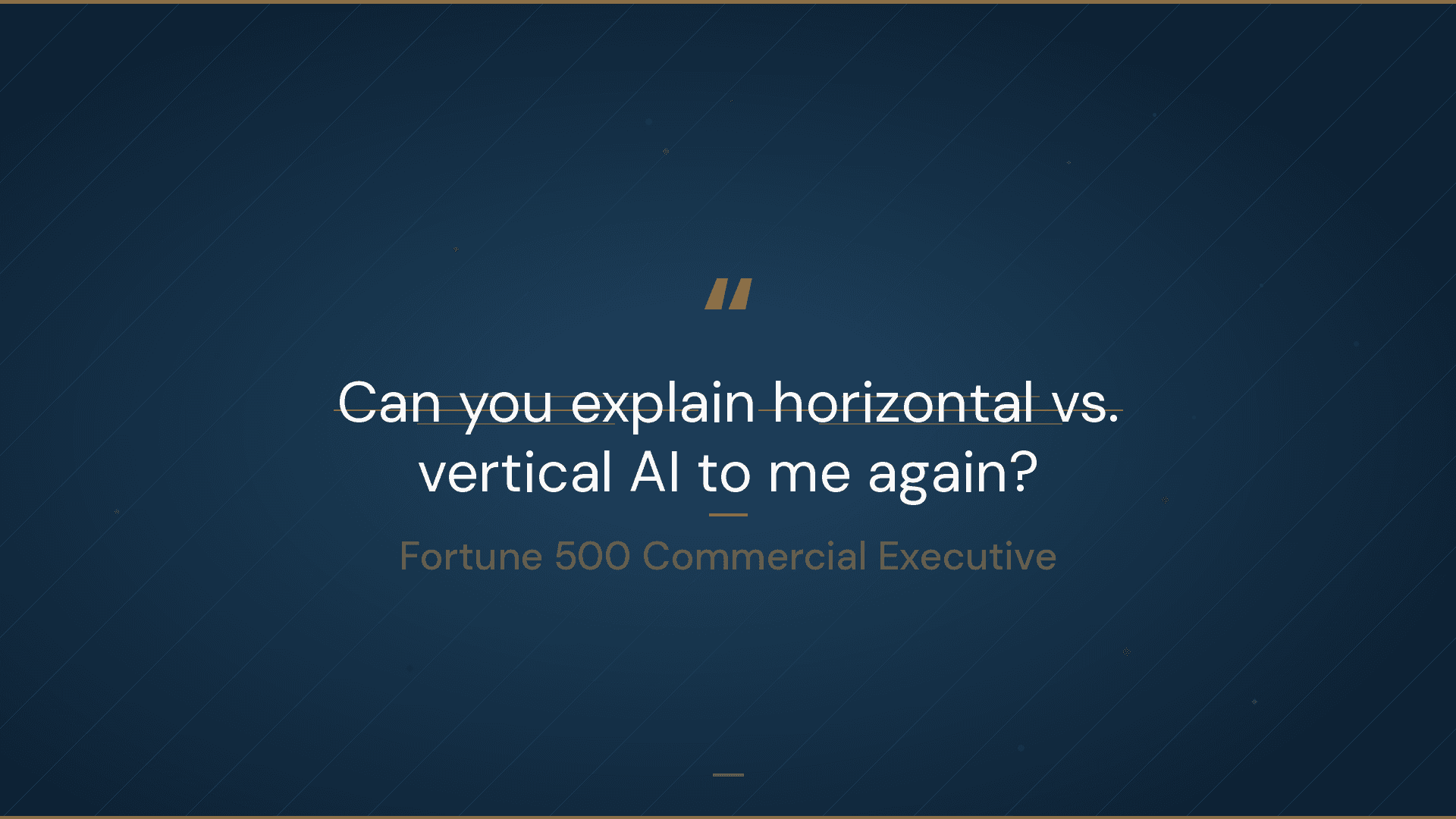
A Fortune 500 commercial executive asked me a question last week.
"Can you explain horizontal vs. vertical AI to me again? I need to communicate to my leadership why we need AI solutions beyond ChatGPT and Copilot, and how what we're looking at is fundamentally different."
She wasn't confused. She's one of the sharpest commercial operators I know. The problem was that her leadership team had been hearing "AI" for two years and couldn't distinguish between a chatbot answering customer questions and an autonomous system compressing their innovation cycle from months to days.
That distinction is the entire game right now. And most enterprises are getting it wrong.
Two Axes of Enterprise AI
Think of enterprise AI adoption as two distinct axes.
Horizontal AI is the broad capability layer. It's the foundation that touches everyone. Think of it as giving every employee in your organization a significantly more capable brain to work with. Claude, ChatGPT, Copilot. These tools improve writing, analysis, research, communication, and decision-making across every function. They don't care if you're in finance or marketing or supply chain. They compress the time between question and answer, between rough draft and polished output, between data and insight.
Vertical AI is the deep domain layer. These are systems built by teams with decades of expertise in specific commercial disciplines, people who have spent careers inside innovation pipelines, consumer research methodologies, R&D workflows, and go-to-market execution. That domain knowledge gets encoded into proprietary data models, proprietary workflows, and purpose-built AI systems that solve specific business problems no general tool can touch.
An AI system that predicts cultural trends 12 to 18 months before traditional research catches up, built on years of signal triangulation across what consumers are saying, seeking, and being influenced by. An autonomous innovation engine that compresses ideation from five days to one hour, built by strategists, designers, and engineers who have run enterprise innovation programs for Fortune 100 companies. A research platform that connects your R&D team with 50,000+ vetted experts, built on 220M+ indexed publications and patents with proprietary matching algorithms refined through thousands of engagements.
These aren't general-purpose tools. They're competitive weapons that took years of domain expertise and proprietary data to build. And that's exactly why they're defensible. You can't replicate them by giving a smart engineer access to an API.
And here's the part most leaders miss: vertical AI systems don't just solve problems. They get better the more you use them. Every innovation cycle that runs through an autonomous engine generates data that makes the next cycle faster and more accurate. Every cultural signal that gets validated against real-world outcomes sharpens the prediction model. Every expert engagement that flows through a research platform builds institutional knowledge that compounds. These aren't static tools you deploy once. They're learning systems that widen your competitive advantage with every use.
That power comes with responsibility. Autonomous systems require governance, validation layers, and human oversight to operate at enterprise scale. The same compounding that creates advantage can compound errors if left unchecked. This is why governance isn't a nice-to-have bolted on after deployment. It's a prerequisite for deploying vertical AI with confidence.
Here's the mistake most enterprises make: they think they have to choose one.
They don't. They need both. And they need them working together.
The 6% That Figured This Out
McKinsey's 2025 State of AI report surveyed thousands of organizations and found that roughly 6% qualify as "high performers," companies where AI contributes meaningfully to EBIT at 5% or more. Not pilot metrics. Not "we saved time on email." Actual bottom-line commercial impact.
Meanwhile, 88% of organizations report using AI in at least one business function, but only a third have moved beyond experimentation into scaled deployment. The gap between using AI and getting value from AI is enormous. And it's widening.
What separates the 6%? They're running both plays simultaneously.
Why Central IT Can't Solve This Alone
Central IT can't build the deep, domain-specific vertical solutions that create actual competitive advantage. They don't have the subject matter expertise. They don't understand the nuances of your innovation pipeline, your packaging development cycle, your consumer insights methodology, or your go-to-market velocity. They can deploy a platform. They can't deploy a competitive weapon.
This approach made sense for ERP systems and CRM platforms. It doesn't make sense for AI.
The Permission Problem
I watched a pilot sit in purgatory for 11 months at a large enterprise. The technology worked. The business case was clear. But the team that identified the problem wasn't the team allowed to solve it. So it went up the chain, down to legal, over to IT, back up for budget approval, down again for security review. By month 11, the original champion had moved on. The pilot was quietly shelved.
That's not a technology problem. That's an org chart problem. And it's the reason most enterprise AI pilots die.
The org chart isn't just slowing things down. It's actively preventing the people closest to commercial problems from deploying the AI solutions that would solve them. When a brand manager spots a consumer trend shift, she shouldn't need 11 months and four approval chains to test a response. When an R&D lead identifies a formulation question that requires expert validation, the answer shouldn't be "submit a request to IT and wait."
AI Moved From Chatbot to Agent
In January, Anthropic launched Claude Cowork. In February, Opus 4.6 and OpenAI's latest model dropped on the same day. Open-source agentic tools are proliferating. The market isn't asking whether AI agents are ready. The market is building them.
This matters on both axes.
On the horizontal side, agentic AI is democratizing complex delegation across the entire workforce. Every employee can now hand off multi-step research, analysis, document creation, and data synthesis to an AI that executes it autonomously. That's not a chatbot answering questions. That's a capable system doing real work.
On the vertical side, agentic architecture is what makes purpose-built AI systems possible in the first place. The same underlying capability that lets Cowork organize your files is what lets an autonomous innovation engine run a full ideation cycle, or a predictive intelligence platform triangulate cultural signals across millions of data points. Agents are the engine underneath both layers.
For enterprise leaders, this creates both opportunity and urgency. The horizontal layer is no longer about giving people a chatbot to ask questions. It's about giving every employee the ability to delegate complex, multi-step work to an AI that executes it autonomously. The companies that move from "AI as search engine with personality" to "AI as complex delegation" will compress cycles across every function.
The Vertical Layer: What It Looks Like in Practice
Here's what vertical AI looks like when it's built by teams who understand the domain, not just the technology.
Board of Innovation: Autonomous Innovation Systems
Board of Innovation builds production-deployed AI systems that replace traditional innovation consulting with autonomous growth engines. What this means for the business: your innovation pipeline stops being a calendar of workshops and becomes a machine that continuously generates, validates, and prioritizes commercial opportunities.
When Walmart deployed BOI's system, they compressed trend-to-factory from months to days and achieved 115x faster ideation. That's not a productivity gain. That's a structural change in how fast a $600B company can respond to market shifts. Nestlé achieved 3x faster time-to-market across 5 continents. A Fortune 100 CPG saw 9x ROI with 25% higher product success rates. Takeda's QDENGA vaccine, supported by BOI's commercial strategy, generated over $500M in sales.
This is the vertical AI that central IT can't build. It requires teams of strategists, designers, and engineers with decades of experience running enterprise innovation programs who have encoded that expertise into autonomous systems. The output isn't a recommendation deck. It's a production-ready engine that gets deployed into your commercial reality and gets smarter with every cycle.
Nichefire: Predictive Cultural Intelligence
Nichefire surfaces where consumer attention is compounding 12 to 18 months before traditional research catches up. What this means for the business: you see the wave before your competitors do, and you have time to build the product, the positioning, and the go-to-market before anyone else is paying attention.
Nestlé identified a $150M opportunity through Nichefire's platform. That's not a trend report. That's $150M in revenue that wouldn't have existed without seeing the signal early enough to act. Kraft Heinz built a $100M innovation pipeline. Forecasting accuracy runs above 90%. When Nestlé launched Vital Pursuit to capitalize on the GLP-1 trend, Nichefire had surfaced that signal months before it hit mainstream consciousness.
No horizontal AI tool gives you this. You can't prompt Claude or ChatGPT and get predictive cultural signals triangulated across what consumers are saying, seeking, and being influenced by. This is proprietary intelligence built on years of signal methodology, and it gets sharper with every prediction that plays out in market.
FifthRow: Consulting as Software
FifthRow replaces traditional strategy consulting with autonomous AI agents that deliver in minutes what used to take weeks and hundreds of thousands of dollars. What this means for the business: the $200,000 consultant engagement that required 4 to 6 weeks of analyst time now runs at 10% of the cost with 80% less manual analysis time. Not as a rough draft. As a fully sourced, presentation-ready output with every source cited and every claim auditable.
The platform runs 150+ expert-built apps across market intelligence, competitive analysis, strategic foresight, regulatory monitoring, and venture building. Each app encodes proven consulting playbooks into teams of autonomous agents that share context, self-correct, and follow structured methodologies. One investment memo app alone orchestrates 44 agents across financials, market data, and competitive signals. Enterprise clients including Samsung, Cisco, Bridgestone, Swiss Re, and Fortune Brands are already running it in production.
The results show up in compressed timelines that change how fast companies can make decisions. A large US insurance company generated 200 venture solutions across 7 problem spaces, launched market-testing microsites in 3 weeks, and saved 4 months of professional services work. A Japanese auto manufacturer hit their full-year venture target in Q1. A US smart home provider went from zero to 3 highly viable ventures in 3 weeks instead of 5 months. A Fortune 500 tobacco company saved 3 months of manual work before idea validation even began.
This isn't a chatbot doing research. These are teams of autonomous agents running end-to-end consulting workflows: research, analysis, synthesis, validation, and reporting. Every run is logged, every source is cited, every output is auditable. And because the system learns from every engagement, the quality compounds. The more you use it, the better it gets at understanding your competitive landscape, your market dynamics, and your strategic priorities.
NotedSource: On-Demand Research & Expert Intelligence
NotedSource is an AI-powered R&D platform that connects enterprise innovation teams with 50,000+ vetted academic and industry experts, leveraging 220M+ peer-reviewed publications and patents. What this means for the business: when your team has a hypothesis, a concept, or a technical question that requires deep scientific expertise, you get an answer in days instead of negotiating a six-month university partnership.
That speed changes the economics of R&D decision-making. Companies like Nike, Mars, General Mills, Johnson & Johnson, and Diageo use NotedSource to validate product concepts, access specialized expertise for formulation challenges, and pressure-test innovation bets before committing millions to development. The difference between getting expert validation in five days versus five months is often the difference between launching first and launching late.
AlignAI: AI Portfolio Governance & Orchestration
Databricks' 2026 State of AI Agents report found that companies with structured AI governance pushed 12x more projects to production. Not 12% more. 12x. AlignAI is the operating system that makes that possible.
What this means for the business: as organizations scale from three AI pilots to thirty, the coordination problem becomes the growth problem. You can't see which initiatives are stalled in legal, which are redundant, and which have the highest revenue upside. AlignAI provides the structured intake, approval workflow, and real-time visibility that keeps AI programs moving from idea to production. Customers like Bread Financial and Geisinger are seeing 10x program productivity and $50M in annual savings.
This is the layer that turns the permission problem into a solved problem. Without it, every vertical AI system you deploy gets bottlenecked by the same org chart friction that killed pilots before AI existed. With it, the commercial initiatives that actually grow the business get unblocked at the pace the technology demands.
How These Layers Work Together
The real power emerges when horizontal and vertical AI feed each other.
When a brand manager uses Claude to draft a brief and that brief gets enriched by Nichefire's predictive signals, the output is categorically different from either tool alone. When an innovation team uses Copilot for daily productivity and BOI's autonomous engine for pipeline generation, the velocity compounds. When FifthRow's strategy agents feed insights into the same data environment that AlignAI governs, the organization doesn't just move faster. It moves faster with visibility and control.
This is the integration layer. And it's where most enterprises have a gap, because horizontal and vertical AI are typically bought by different teams, managed by different budgets, and measured by different KPIs.
The 6% closed that gap.
The Full Adoption Strategy
If you're presenting this to your leadership team, here's the framework. And the most important thing I can tell you: these aren't sequential phases. They must run in parallel, or you lose your edge.
Smarter People. Deploy broad AI capabilities across the organization. Get every employee access to agentic tools. Move from "AI as chatbot" to "AI as complex delegation." This is the permission layer. Let the person with the problem become the person allowed to solve it. Central IT owns this.
Smarter Business. Identify your highest-value commercial workflows: innovation pipeline, consumer insights, research validation, go-to-market execution, AI program governance. Deploy purpose-built AI systems that compress those specific cycles from months to days. This is where you bring in partners who understand your domain, not just the technology. Business leaders and strategic partners own this.
Integration. Connect both layers so they feed each other. Your employees' daily AI usage should be enriched by the outputs of your vertical systems. Your vertical systems should be informed by the insights your employees surface through their horizontal tools. This is where compounding happens. The C-suite owns this, because integration requires authority that crosses functional boundaries. In practice, that means one executive with a mandate to connect AI investments across business units. Not a committee. Not a task force. A single point of accountability with budget authority and a direct line to the CEO.
The companies waiting to finish one before starting the next are already behind. The 6% are running all three simultaneously. That's not a coincidence.
The Window Is Closing
The question isn't "should we adopt AI?" That ship sailed. The question isn't even "which AI platform should we choose?" Single LLM selection is the norm right now, and it's the worst move you can make.
The question is: "Are we making our people smarter, our business smarter, or both?"
Smarter people is horizontal. Every employee gets more capable. They research faster, communicate better, analyze deeper. That's necessary. But if every company in your category does the same thing, nobody gains an edge. Smarter people is the cost of playing.
Smarter business is vertical. Your most critical workflows get rebuilt with AI at the core. Your innovation pipeline, your consumer intelligence, your research validation, your go-to-market engine. These systems are built on your data, your domain, your commercial reality. They can't be replicated by handing a competitor the same chatbot license. Smarter business is how you win.
Here's the urgency: vertical AI systems compound. Every quarter you wait, the companies that started building theirs pull further ahead. Their prediction models get sharper. Their innovation engines get faster. Their data flywheels spin harder. The gap doesn't stay the same. It widens. And it widens at an accelerating rate.
Three frontier models launched in six days in December. Cowork shipped in January. Opus 4.6 and OpenAI's latest dropped on the same day in February. The capability curve isn't slowing down. The enterprises that match that pace with both horizontal adoption and vertical depth will define the next era of their industries. The ones still debating which chatbot to license will be defined by it.
That's the conversation your leadership team needs to have. Not next quarter. Now.
Jason Hauer CEO & Founder, HauerX Holdings A portfolio of AI-native companies driving growth for the biggest brands in the world, including Coca-Cola, Nike, Walmart, and Allianz.