Brian Niccol walked into Starbucks in September 2024 and found a company that'd been optimizing itself into irrelevance. Mobile throughput was up. The experience was gone. Years of app-driven promotions and operational efficiency had slowly taken apart what customers had actually been paying for, which wasn't the coffee. It was the feeling of being somewhere that knew them.
“Back to Starbucks” got described in the press as a turnaround plan. It was closer to a restoration project.
What Niccol Was Actually Trying to Get Back
The third-place idea, the coffeehouse that sits between home and work, wasn't a positioning statement. It was the organizing principle behind how Starbucks trained its people, designed its stores, and built customer relationships over decades. That thing eroded.
Mobile orders scaled and baristas spent more of their shifts assembling drinks against a queue. Customers showed up at the counter to collect something that'd been sitting there. With the condiment bar gone, even adding milk to a coffee required help from the team behind the counter. Each small change affected how the coffeehouse felt to the people using it.
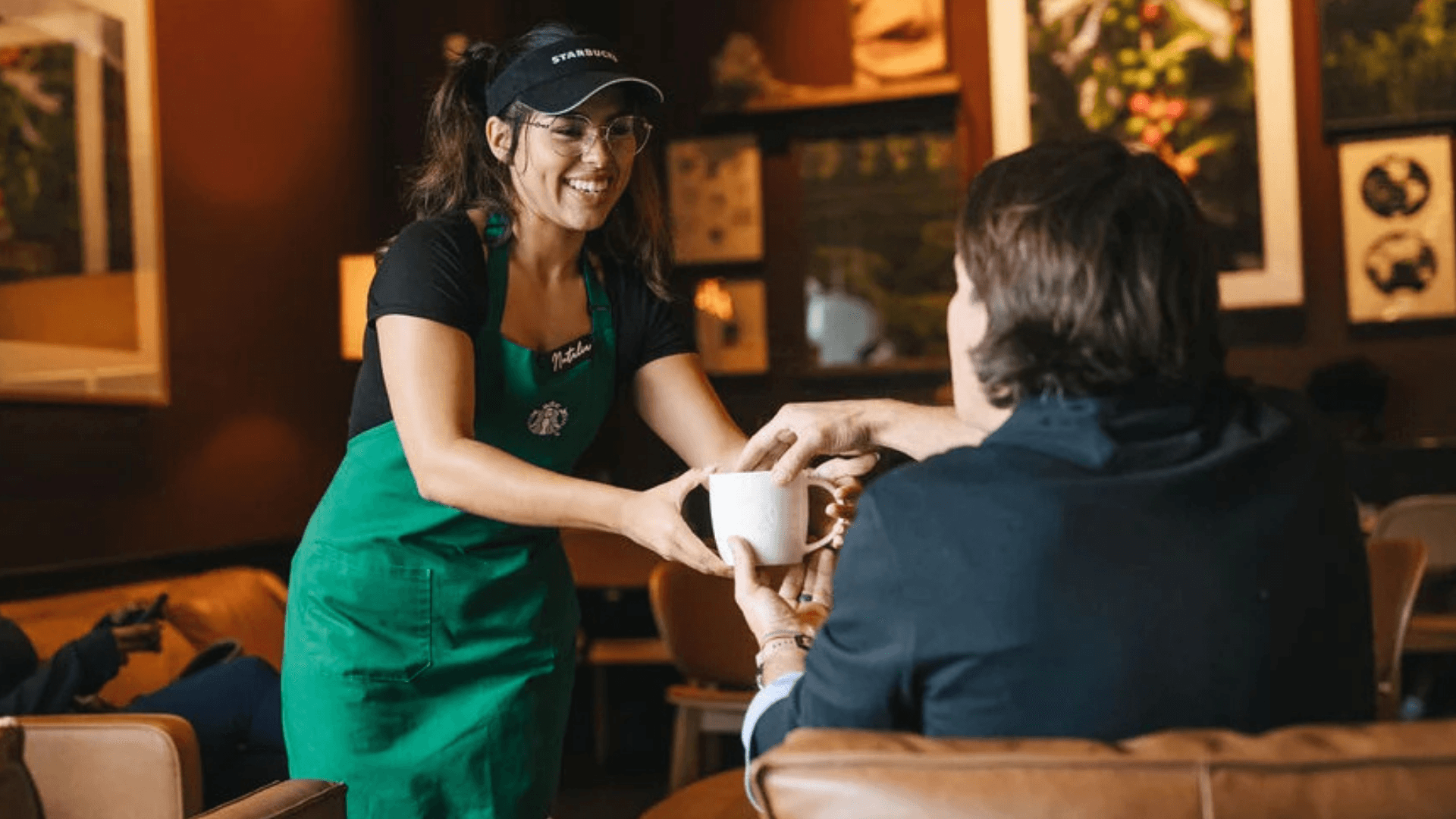
Niccol spent his first year walking a lot of this back. Starbucks changed its coffeehouse code of conduct in early 2025 to reserve its spaces for customers. The condiment bar returned, and people staying in could have their coffee served in a ceramic mug. Baristas began writing notes on cups again. These changes were part of the company's Back to Starbucks plan.
Some of those original decisions made sense when they were made. Starbucks found out what they did to the stores by running them and watching what happened. Niccol's team had a clear idea of the experience it wanted to restore, which gave it a way to decide what needed to change.
Where AI Fits
The plan gave AI a specific job inside the coffeehouse. Starbucks wanted its people to spend more time making drinks well and connecting with customers. Technology had to help them do that during a busy shift.
In its June 2026 AI update, Starbucks describes Green Dot Assist as a companion that answers baristas' questions about recipes and service routines. A new employee can look something up in the flow of work. Extending AI to equipment monitoring and maintenance is part of the company's plan for what comes next.
Smart Queue sequences orders arriving from the café, drive-through, mobile app and delivery channels. The work behind the counter has to account for customers who ordered in different ways and expect their drinks at different times.
At its January Investor Day, Starbucks reported average peak service times below four minutes across café and drive-through coffeehouses in Q1 FY26. It described that progress as part of the wider Green Apron Service model, which combines staffing, equipment and technology. The result belongs to the operating model as a whole.
For a customer waiting at the counter, a useful change is easy to recognize. Their drink arrives when expected, and the person handing it over has enough time to make the exchange feel personal. That's the experience the plan is meant to support.
How the Plan Kept Evolving
Starbucks also tried NomadGo's automated inventory counting, rolling it out in North America in 2025 to help stores keep products available. Reuters reported in May 2026 that Starbucks had retired the program after problems with miscounts and misidentified products. The company said it was standardizing inventory counting and continuing work on replenishment.
For a leadership team, I think the useful lesson is how a clear strategy can guide a change in course. Customers still needed the drink they came for to be available. The method for keeping it in stock could change as Starbucks learned more from its stores.
That decision sits alongside the continuing work on Green Dot Assist and Smart Queue. Starbucks had a service plan it could keep working toward while changing individual tools. Its people needed a reliable way to do the work, and the experience in the coffeehouse gave leadership a way to judge whether the approach was helping.
What the Early Results Show
The Q1 FY26 results, reported January 28, give an early read on the broader turnaround. Same-store sales grew 4% globally. Starbucks recorded positive U.S. comparable transaction growth for the first time in eight quarters, while consolidated revenue reached $9.9 billion, up 6% year over year. Those results preceded the inventory-tool withdrawal.
Starbucks also relaunched Rewards in March 2026. Members can earn Stars faster as they move through the levels. Gold and Reserve members' Stars don't expire while they maintain their status.
At Investor Day in January, the company outlined new menu offerings and next-generation equipment, including Mastrena 3. It expected to add more than 25,000 U.S. café seats by the end of FY26. Its FY2028 targets included at least 5% net revenue growth, a 13.5% to 15% non-GAAP operating margin, and non-GAAP earnings per share of $3.35 to $4.00.
STARBUCKS · RESULTS AND TARGETS
Sources: Starbucks Q1 FY26 results · January 2026 Investor Day
These figures describe a business working through a broad turnaround. Staffing and the menu were changing alongside the technology. My read is that the plan becomes easier to execute when each operating decision has a clear connection to what Starbucks wants a customer to experience on the next visit.
Why This Matters for Leaders Outside Retail
Most organizations have some version of this problem. There's an identity built over time, something customers or employees or partners actually value, and then there are operational decisions made for good reasons that slowly work against it. The erosion doesn't show up in revenue first. It shows up in frequency, in sentiment, in the quiet kind of disengagement that takes years to reverse once it sets in.
Niccol's first move was diagnostic. He had to figure out what Starbucks' equity actually was before he could decide what needed protecting. That's the starting point for any leader in this situation. Get an honest read on what people actually value about what you do, and whether your current operations are serving that or consuming it.
For a company whose relationships depend on frontline service, there's value in putting AI into the work that takes people away from customers. Give someone a reliable answer while they're doing the job, and they have more room to use their judgment. The test is what happens during the shift, including the extra checking or correction a tool creates.
The inventory decision makes that test concrete. A tool can fit the strategy when it's introduced and still need to change once people use it every day. Leaders have to leave room for that evidence to reach them. The person correcting a count during a busy shift knows something about the deployment that an adoption dashboard will miss.
Where to take this.
Find where your people are spending time on things that don't produce value for whoever you're ultimately serving. That's usually where AI has the fastest return. The gains from that kind of deployment create the capacity for the work that actually builds relationships.
Measure what the change does for the customer. If an AI tool saves time, follow where that time goes and whether service improves. Include the work people do to check its output. Your team should be able to show how the change supports the experience you want customers to return for.
Give the people using the tool a direct way to tell you when it gets in the way. Decide who can act on that feedback and what evidence would justify changing course. That belongs in the plan from the start, especially once a deployment reaches hundreds or thousands of locations.
Start with a moment your customers care about and spend time with the people responsible for it. Ask where the work gets difficult. As you introduce AI, keep returning to that same moment to see what changed and what your team needs next.
From the portfolio
Board of Innovation helps enterprises redesign the operating systems behind customer experience. Starbucks shows why that work starts with what customers value. Giving frontline teams better tools also means paying attention to how those tools perform in daily work, and adjusting the operating plan as the company learns.
Where is your team spending time that should be going to customers? Tell me what’s happening, and we can look at where BOI could help.
See how BOI builds for growth