AI and design leaders from Canadian Tire, ServiceNow, and Chai kept arriving at the same place from completely different directions.
A $12 billion retailer, a design leader at one of the largest enterprise software companies in the world, and a guy building autonomous AI workforces in Brazilian sugar cane fields. On the same stage in Chicago.
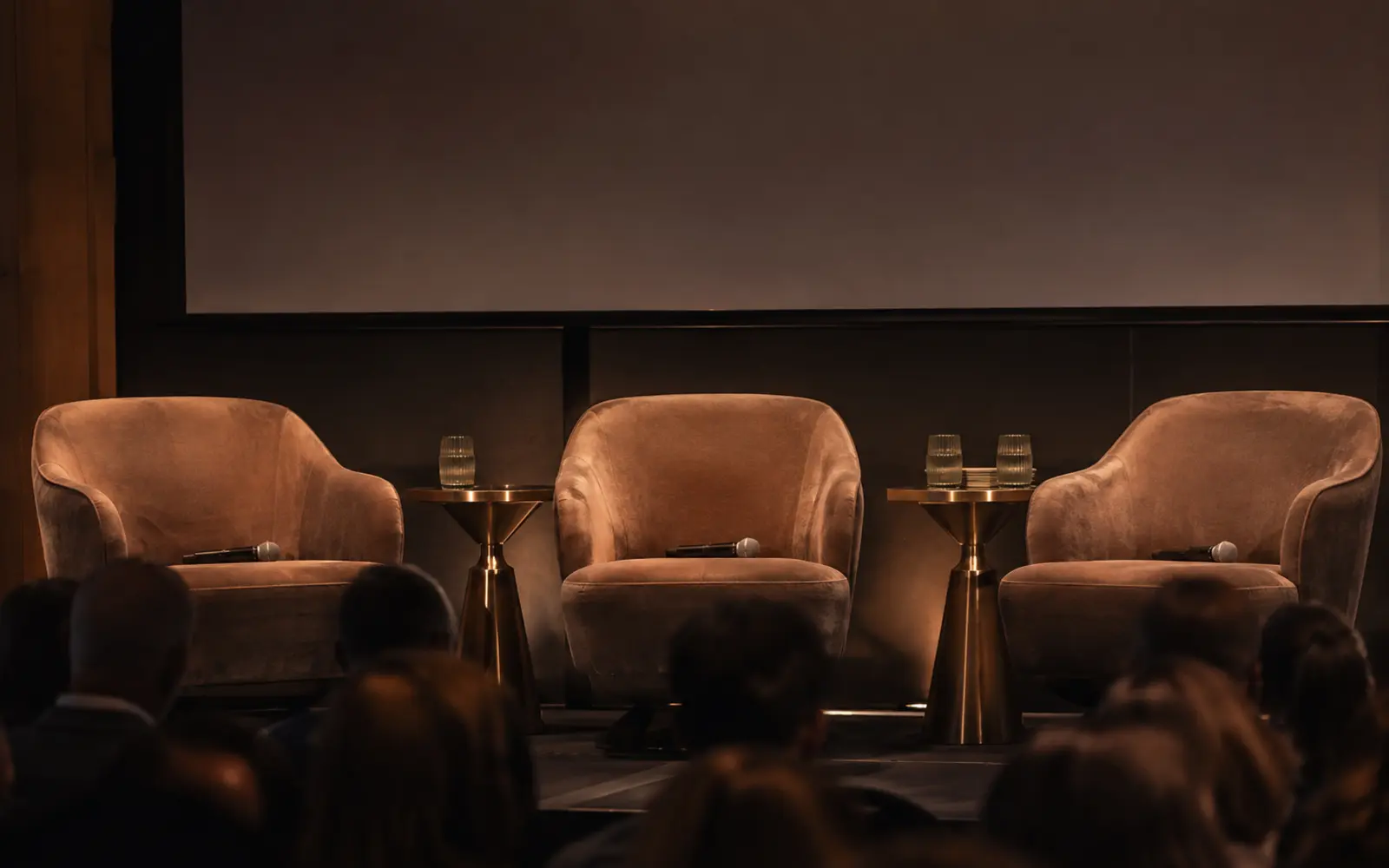
I was moderating a panel at The Future Of conference with Anthony Wolf from Canadian Tire, Carly Price from ServiceNow, and Roger Rohatgi, Chief AI Officer at Chai. John Gleason and the team behind The Future Of had built a room worth being in: P&G, IBM, Whirlpool, KraftHeinz, Colgate, Mondelez, 3M, HauerX Holdings, BrandRank.AI all working through the same questions on the same day. Phil Gilbert opened the morning. Phil Duncan from P&G did a fireside moderated by Bob Jennings from 3D Color. The hallway conversations alone were worth the trip.
But something happened on stage that I didn't expect. These three kept arriving at the same place from completely different directions. And the place they kept arriving at is something I think most companies are getting wrong.
Canadian Tire Doesn't Have an AI Strategy
Anthony told the room that Canadian Tire doesn't have an AI strategy.
I watched people's faces shift. In a room full of leaders who are building AI strategies, roadmaps, and governance frameworks, someone from a $12 billion company just said they don't have one.
AI is in service of their corporate strategy. That's it. And the more I've sat with it, the more I think the act of creating a separate AI strategy might be the mistake itself. The moment you separate it, you've turned it into a project. A thing to manage. And that's exactly what most companies did with digital transformation. Separate team. Separate budget. Separate initiative. And most of them never finished.
Roger Sees the Evidence
Roger's team at Chai walks into companies that say they're ready for AI, and here's what they actually find: data that's a mess, processes that are disconnected, cultures that are confused, legacy systems nobody replaced. Digital transformations that got 80% done and moved to the back burner. AI doesn't clean any of that up. It inherits it. And then it scales it at a speed your organization has never operated at before.
Two people. Two completely different vantage points. Same diagnosis.
The problem isn't AI. It's everything you didn't finish before AI showed up.
Then Carly Complicated Things in the Best Possible Way
She joined ServiceNow about ten months ago. AI was already woven into everything. The question wasn't whether to use it. It was how fast. And the breakthroughs she's seeing aren't coming from a strategy. They're coming from people.
Hungry, proactive individuals who are just figuring it out. A designer who created a prompt template that feeds directly into Figma Make. Another who went into Terminal and started building. Carly organized a two-day workshop that used AI to facilitate synthesis across all their portals and 20 prototypes came out of it.
That workshop is worth pausing on. It compressed what would have been six to eight weeks of work into two days. But the insight isn't speed. The old timeline existed because synthesis was expensive. AI made it cheap. The six weeks wasn't the work. It was the cost structure the process was designed around. Which makes you wonder: how many of your slow processes are slow because the work is hard, and how many are slow because they were built for a world where certain things cost more than they do now?
Her team has since built custom Claude skills for heuristic evaluation. Junior designers running mini usability audits before they even share their work. Demo scripts built from PRDs, turned into coded components, connected through to engineering. The whole concept-to-testable-product pipeline compressed in ways that would have been hard to imagine a year ago.
And Carly isn't overseeing this from a conference room. She uses voice memos on walks for meeting notes. Builds prototypes herself. When a designer showed her something impressive, her first question was "show me the steps." Then she started doing it.
Here's why that matters in the context of what Roger and Anthony were saying. Roger says companies aren't ready. Anthony says the readiness problem is organizational. Carly is showing what actual readiness looks like, and it looks nothing like a transformation program. It looks like a leader who's in the tools creating space for people to figure it out. No roadmap. No separate AI strategy. Just conditions for experimentation and a leader who goes first.
The Numbers From the Stage
The Future Of Conference · Canadian Tire · ServiceNow · Chai · 2026
70 / 20 / 10: Anthony Wolf's transformation formula at Canadian Tire. 70% people, 20% data and technology, 10% models. The heaviest lift has nothing to do with the tech stack.
6 to 8 weeks turned into 2 days: What Carly Price's team at ServiceNow compressed when AI eliminated the cost structure their synthesis process was designed around. The bottleneck wasn't the work. It was the economics the work was built for.
1,500: Micro occasions Canadian Tire now defines from first-party data, scaled store by store, week by week. Not a faster version of the old model. A fundamentally different one.
The Die Casting
Anthony's analogy keeps rattling around in my head. AI isn't like bringing a power drill to replace a screwdriver. It's like a die casting that replaces the entire need to screw something together in the first place.
Canadian Tire has millions of loyalty program users. Deep first-party data on what customers are buying, when, and in what combinations. They could have used AI to optimize how they sell products. Faster recommendations, better targeting, the obvious stuff. Instead, they reimagined what they're selling around. Not products. Occasions. What's the weekend going to look like for a store operator near a lake during fishing season versus an urban store near a music festival? 1,500 micro occasions, defined from first-party data, scaled store by store, week by week.
That's not a faster version of Canadian Tire. That's a different company.
But here's the part of the die casting that nobody said out loud. If AI replaces the need to screw things together, then the expertise people built around screwing things together is suddenly worth less. The 70% people problem Anthony talks about, 10% models, 20% data and tech, 70% people, it's not just about adoption and training. It's about identity. What happens when the thing that made you an expert is the thing AI just collapsed?
There Is No Other Side
Anthony named the emotional weight of this more honestly than I've heard anyone do it. There's a maturity curve with AI, he said. And it doesn't have an ending. It just keeps going. You can't cross a bridge and tell your board you're on the other side.
There is no other side.
Every leader going through this is feeling the same excitement, the same fear, the same apprehension, all at once. That's just what leading in the age of AI feels like. And every change management playbook that assumes you're moving from state A to state B breaks when there is no state B.
The Trust Architecture
Roger pulled the camera back furthest. He shared a framework from his work with MIT: the way work has always been done is human to human to human. H, H, H, H in the chain. Now you introduce an agent. H, H, H, A. Then another. The question stops being about tools and starts being about decisions. Which ones are you willing to hand over? And he believes that's the biggest question organizations will face. Not which AI to buy. Which decisions to trust it with.
Most companies don't have a framework for that. They're trusting AI with everything or trusting it with nothing. The ones who build trust architecture first, with clear principles for what goes to humans and what goes to agents, are going to move fastest.
The Missing Sixth Layer
Roger also made an argument that connects everything I heard on that stage. Jensen Huang's AI stack has five layers: energy, infrastructure, chips, models, applications. Roger argues there's a missing sixth layer: experience. Everything else is built. But people aren't adopting it. They're confused by it. The experience layer is what's missing.
And I think that's where all three of these perspectives crash into each other in a way that matters. Carly's team is building the experience layer inside ServiceNow one prototype and one Claude skill at a time. Anthony's team is building it at Canadian Tire by completely redesigning the relationship between data and the customer. Roger is arguing it's the most important layer in the entire AI stack and most companies don't even see it.
If the first five layers are commoditizing, the only place left to build something defensible is the layer closest to humans. Design leaders, the people who understand experience, who understand how humans actually interact with systems, are sitting on the most valuable real estate in the AI landscape. And most of them are still waiting for someone to hand them a strategy.
What To Do This Week
An audience member asked a question during Q&A that captured where most of the room actually lives. He's inside an enterprise that can't roll out AI tools fast enough. The internal tools aren't as capable as what's available externally. He's stuck in a gray space. Use the company tools and fall behind. Experiment on your own and create risk. That tension is everywhere right now, and it won't get resolved by a governance framework.
My advice: get your hands on the best possible tools. Personally. Even if it's outside the enterprise firewall. Just be smart about it. Don't violate your company's data or IP policies. But don't let corporate IT be the thing that defines your understanding of what's possible.
If you haven't built something with AI, you don't fully understand what it can do and you don't understand where it falls short. Both matter. And right now, both are moving faster than most organizations can keep up with.
The competitive advantage isn't having AI. Everyone's going to have AI. Same models, same tools, same infrastructure. The advantage is how fast your organization can absorb it. And absorption is a function of culture, trust, and leadership. Not technology procurement.
From The Portfolio
That exercise will surface where your transformation is stalling, and it's almost never at the technology layer. It's the organizational layer. The identity layer. The assumption layer.
Board of Innovation is an AI Transformation Studio that helps mid-market and Fortune 500 companies redesign how they work when AI removes the assumptions their operating model was built on. The 70/20/10 split Anthony described, where 70% of the challenge is people, is exactly where BOI starts. They don't deploy tools. They redesign how organizations absorb change. boardofinnovation.com
AlignAI is a purpose-built platform for accelerating how enterprises refine and approve AI initiatives. When Roger talks about companies trusting AI with everything or trusting it with nothing, that's the gap between experimentation and production that AlignAI closes. Structure for the refinement and approval process so initiatives move instead of stall. getalignai.com. They're also launching an AI COE Collective in partnership with Slalom, bringing together AI leaders across enterprises to share what's working and what isn't. Worth a look if you're on an island building or scaling AI in your enterprise. getalignai.com/ai-coe-collective
Where I'll Be Next
May 21: AUTONOMOUS: OBSOLETE (Virtual). Board of Innovation is gathering 5,000+ senior leaders for a half-day virtual summit built around one premise: AI is breaking the assumptions your business model, workflows, and organization were built on. Intercom's CTO on why most AI transformations are too polite. Zapier's CEO on redesigning an entire value proposition. A live obsolescence audit with leaders from Mars, GSK, and KPN. Free to attend. Register at autonomoussummit.ai.
May 28: 1871 Emerging Tech Innovation Summit (Chicago). I'll be back in Chicago for the 1871 Emerging Tech Innovation Summit. Chicago has always been a builder's city. Operators and founders who are actually shipping tell you what's working and what isn't. Demos from high-traction startups building in AI, blockchain, and quantum. And the hardest questions in emerging tech right now: what's real, what breaks at scale, and what's getting funded in a production-first market. If you're building or deploying in Chicago, this is the room. Supported by Microsoft, Deloitte, Bosch, BOM, and United. TGB readers can use code JHCOMP for complimentary registration at 1871.com.
Let me know if you end up attending either event. I'd love to compare notes.
In AI, the maturity curve doesn't end. There is no other side. There's just the willingness to start and to keep going.
Reach out if you're wrestling with any of this. I'd love to think it through with you.
Jason Hauer Founder & CEO, HauerX Holdings jason@hauerX.com
Frequently Asked Questions
What did Canadian Tire, ServiceNow, and Chai leaders agree on about AI transformation?
All three leaders kept arriving at the same place from completely different directions. The problem isn't AI itself. It's everything organizations didn't finish before AI showed up. Anthony Wolf said Canadian Tire doesn't have an AI strategy because AI is in service of corporate strategy, not separate from it. Roger Rohatgi's team at Chai walks into companies that say they're ready and finds disconnected data, confused cultures, and 80%-done digital transformations on the back burner. Carly Price at ServiceNow is building the experience layer one prototype at a time. Different vantage points, same diagnosis.
What does 'there is no other side' mean in AI transformation?
Anthony Wolf at Canadian Tire put it more honestly than most leaders will say out loud: the maturity curve with AI doesn't have an ending. It just keeps going. You can't cross a bridge and tell your board you're on the other side. Every change management playbook that assumes you're moving from state A to state B breaks when there is no state B. Leading in the age of AI means feeling the excitement, fear, and apprehension all at once and continuing to start every cycle from the beginning.
Why is creating a separate AI strategy itself a mistake?
The moment you separate AI as its own strategy, you've turned it into a project. A thing to manage. A workstream with a sponsor, a timeline, and a definition of done. That's exactly what most companies did with digital transformation. Separate team. Separate budget. Separate initiative. Most of them never finished. AI in service of corporate strategy works. AI strategy as its own discipline turns into another transformation program that stalls. Canadian Tire doesn't have an AI strategy. It has AI in service of its corporate strategy.
What is the 'sixth layer' of the AI stack that most enterprises overlook?
Jensen Huang's AI stack has five layers: energy, infrastructure, chips, models, applications. Roger Rohatgi argues there's a missing sixth: experience. Everything below is being built and commoditized. The only place left to build something defensible is the layer closest to humans. Design leaders who understand experience are sitting on the most valuable real estate in the AI landscape. Most are still waiting for someone to hand them a strategy. The companies that build the experience layer first will compound advantage. The rest are buying tools nobody wants to use.
How should leaders build a 'trust architecture' for what AI agents can decide?
Roger Rohatgi's framing: work has been human to human to human. H, H, H, H in the chain. Now you introduce an agent. H, H, H, A. Then another. The question stops being about tools and starts being about decisions. Which ones are you willing to hand over? Most companies are trusting AI with everything or trusting it with nothing. The ones who build trust architecture first, with clear principles for what goes to humans and what goes to agents, will move fastest. Not which AI to buy. Which decisions to trust it with.