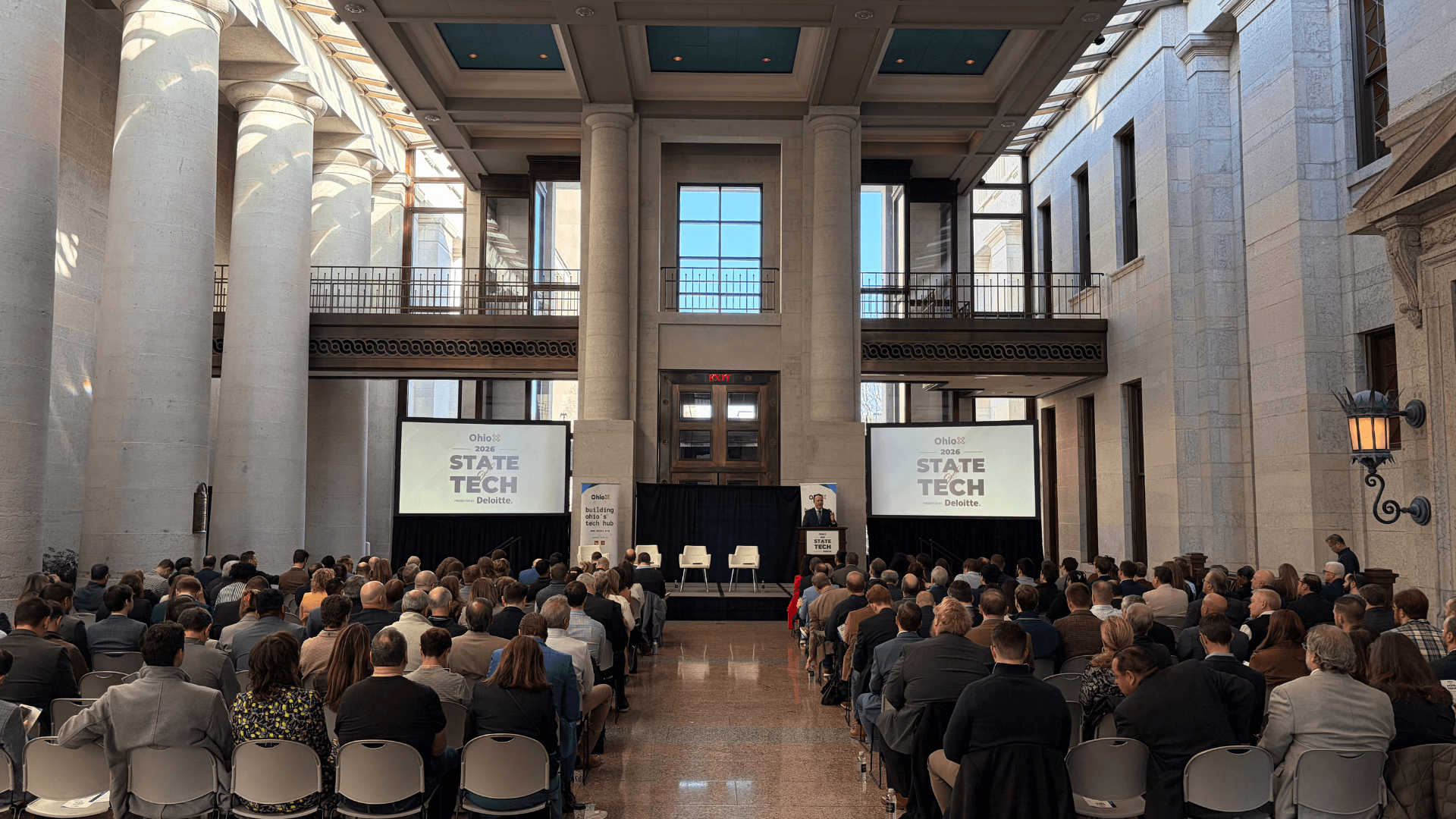
I spent this morning at the Ohio Statehouse for the 3rd annual OhioX State of Tech, presented by Deloitte. The event brought together business leaders, policymakers, and builders to take stock of where Ohio stands in the AI economy. The room was full. The energy was high. And for the first time in three years of this event, the conversation was no longer about whether AI matters. It was about strategy, speed, and urgency.
That shift matters. And it has implications far beyond Columbus.
The Infrastructure Is Not Theoretical
OhioX President and CEO Chris Berry opened with what he called the "full-stack state" thesis, and the data backing it up is hard to argue with.
Columbus is now the sixth most established data center market in the world, outpacing both Chicago and Salt Lake City according to the "America's AI Surge" report from the American Edge Project and PitchBook published in December 2025. The state has 191 active data centers, with 102 more announced or under construction. Since 2019, $2.3 billion in AI-related venture capital has been deployed across 244 deals in Ohio, with logistics and manufacturing sectors rising. Meta picked Northwest Ohio for its newest $800 million AI-optimized data center. AWS landed a $5 billion investment in Fayette County for new data centers. Google is investing another $2.3 billion into Ohio's cloud and AI infrastructure and was confirmed as the company behind a 500,000-square-foot data center in Scioto County. The Stargate Project, the consortium of OpenAI, Oracle, and SoftBank, chose Ohio as one of its five new national AI data center sites, with SoftBank investing $3 billion in an Ohio factory for OpenAI data center manufacturing.
This is real. It's happening now. 172,176 construction jobs. 25,500 permanent operating positions. And Oklo, the nuclear energy startup, is building its Aurora Powerhouse, a fast-fission, passively-cooled "Power Campus" that scales incrementally to 1.2 gigawatts in Pike County. Meta has already inked a 20-year deal with Vistra to upgrade Ohio's Perry and Davis-Besse nuclear plants and tapped Oklo for a futuristic site in Pike County, locking in power for what they're calling the Prometheus supercluster. Ohio's atomic legacy is becoming its AI advantage.
Berry's framing was right: Ohio has the power, the capital, and the compute. The foundation is here.
The Stack Goes Deeper Than Data Centers
What made Berry's presentation compelling was the second layer of his thesis: intelligence, meaning the human side.
Ohio became the first state in the country to require K-12 public schools to adopt AI policies. House Bill 96 requires every school district to have formal AI policy in place by July 1, 2026, and the state has already launched an AI Toolkit and AI in Education Strategy to support implementation. Miami University and Butler Tech just unveiled a $31 million Innovation Hub for advanced manufacturing. Columbus State hit a $60 million funding milestone for its Advanced Manufacturing Center. Bowling Green State University is set to be the first in the nation to offer an "AI + X" bachelor's degree, embedding AI training into political science, education, and other non-technical programs. Ohio State launched its AI(X) Hub to lead the next era of artificial intelligence research, and partnered with Meta to launch a STEM Innovation Hub for next-gen workforce. The University of Cincinnati went all-in with BearcatGPT, making AI tools available across classrooms for students, faculty, and staff.
On the industry side, the state's TechCred program just awarded a record $9.9 million in its latest round, helping businesses reskill and upskill their workforce on technologies like AI. Other states are now copying the model. Anduril Industries is building Arsenal-1, a nearly $1 billion facility at Rickenbacker airport south of Columbus, expecting 4,000 direct jobs. They went from clean-sheet design of the YFQ-44A autonomous fighter jet to flight tested in 365 days, with production expected in Q2 of this year. No cockpit. No pilot. Built by Ohioans, 30 minutes from where we were sitting.
And then there is the capital side. Heartland Ventures is launching its $60 million Fund III to power what they're calling America's reindustrialization, connecting technology startups directly to nearly 1,000 Midwestern industrial owner-operators who serve as both investors and customers. The O.H.I.O. Fund, launched by Mark Kvamme and Ray Leach in June 2024, has hit a $356 million capital milestone in under two years, generating $75 million in returns and actively relocating companies from California to Ohio. They just brought Hyperframe's manufacturing from California to Columbus. With an expanding team and 30 deals closed, they're proving that Ohio's "balanced" investment model is the new engine for Midwest growth.
Berry called it the "full-stack state," infrastructure, intelligence, and market fit all converging. I think he is right. The foundation is being built. But the building needs occupants.
"The Question Is Not Whether AI Will Change Our World, But How We Choose to Shape That Change"
Adarsh (AD) Desai, a principal at Deloitte who leads AI and data strategy for the state of Ohio, delivered the keynote. AD has 20 years in the space and previously built the Center for Excellence for AI at the World Bank. His message was direct: the gap isn't technology. It's adoption.
He walked the room through an illustration. Imagine you want to open a bakery in a small Ohio town. Today, you Google it, wade through a maze of city, county, and state licensing pages, and hope for the best. In the near future, you pull out your phone, open one app, say "I want to open a bakery," and an AI-powered assistant walks you through the entire process seamlessly. That's not science fiction. That's what Ohio's existing Ohio ID infrastructure could become with the right AI layer on top.
He extended the vision further: predictive maintenance for roads and bridges using traffic and weather data instead of reactive pothole-filling, AI-powered fraud detection protecting taxpayer dollars in real time, intelligent citizen service portals available 24/7 as a single digital front door to all state services.
But AD's most important point came in three words: act with urgency.
"I often see agencies and leaders in a state of analysis paralysis," he said. "It helps to start working with AI, to build that familiarity, that fluency. Start piloting lower-risk, higher-value solutions. Take the lessons and create a virtuous cycle of innovation. But the key is to act. And the time is now."
He shared his own stack for what needs to happen: clear AI strategy at the agency level, workforce skills development, robust data governance and interoperability, meaningful private sector engagement, and responsible governance. Then he said something that should echo well beyond government: "It is not the technology that is the barrier. It is all of the other things that need to work together with the technology."
If you're running a Fortune 500 company or a 200-person growth business, urgency should be your word for 2026.
The Question I Asked
I stood up during the Q&A and asked AD a question that I think about constantly: "You talked about creating urgency. How do we actually manufacture more of it? How do we set the expectation from a leadership perspective that urgency is the standard?"
His answer was honest. "It is a tough question," he said. The leaders he works with in government are often motivated but practically overwhelmed by budgets, people constraints, and policy friction. Where he has seen it work, there is a leader at the top who says, "This is important, we are going to do it, and if you fail, it is okay." That permission, that air cover, is the key ingredient.
That answer applies everywhere. Not just in government. In every enterprise. If you're the leader of your org or function, you have two choices: move now and learn as you go, or wait for perfect and watch your competitors pull away. The organizations moving fastest on AI all share one trait. A leader at the top who decided that the cost of inaction is greater than the cost of imperfection. The companies still waiting for the perfect use case, the perfect vendor, the perfect pilot? They're already behind.
The Policy Panel: Urgency Meets Education
The event closed with a panel of Ohio state legislators: Senator Michele Reynolds, Representative David Thomas, and Representative Melanie Miller, moderated by Spencer Gross of High Bridge Consulting.
Senator Reynolds framed it clearly: "For the first time in decades, Ohio is positioned not just to participate in this tech economy, but to actually lead it. We have alignment with our infrastructure, with our talent pipeline, we have policy alignment. All of these things are converging at the same time. This is our moment."
She went further on workforce, and this is where her message connects to every business leader reading this: "We need to move education at the speed of industry. If AI tools are able to evolve every few months, then a curriculum cannot take five years to catch up. We need to master AI before it masters us."
She made the case for lifelong learning becoming the norm, not the exception, noting that a degree earned 22 years ago may not be enough in this environment. And she broadened the talent pipeline beyond traditional paths: returning citizens, veterans, rural communities, people with disabilities. "Whoever wants to come and learn these new skills, we need to let them come."
Representative Thomas brought a tax policy lens that hit differently. Ohio has over 6,000 taxing jurisdictions, the most in the nation. Just on local income tax, roughly 600-700 entities are collecting it, requiring 1,300 HRSA employees whose only job is to administer that collection. The duplication is staggering. His point: government should be asking technology companies not just "how does this make my life easier?" but "how does this save me money and lower costs for taxpayers?"
Representative Miller emphasized the need for public-private partnership in both directions. "If you are not in this space, what you do not know, you are afraid of. And when you are afraid, you want to over-regulate." Her request to the room was simple: reach out to your legislators, invite them into your businesses, help them understand the technology so they do not regulate out of fear.
What This Means for Enterprise Leaders
Here's my takeaway, and where the HauerX lens comes in.
Ohio has done something remarkable in a short period of time. The infrastructure is here. The capital is flowing. The policy framework is forming. The education pipeline is being rebuilt. This is what a full-stack AI economy looks like in its early chapters.
But the hardest part isn't infrastructure or policy. It's adoption at the enterprise level.
The same analysis paralysis that AD described in government agencies is alive and well inside corporate America. I see it every day. Leaders who know AI matters but haven't yet committed to the speed of change required. Companies that have run pilots but haven't moved to production. Teams that have been trained on tools but haven't redesigned the work itself.
The urgency Senator Reynolds described for education applies just as directly to business. If AI capabilities are evolving every few months, your strategy can't take 18 months to finalize. If your competitor is compressing timelines from weeks to hours, your quarterly planning cycle is a liability, not an asset.
Ohio is building the infrastructure for the next economy. The question is whether the businesses operating inside that economy will match the pace. The state is moving. The policy is forming. The capital is deploying.
The leaders who act with urgency, who empower their teams, who start building today, they won't just participate. They'll define the next chapter.
Speed compounds. That's true for states. It's true for companies. And it's especially true right now.
Jason Hauer is CEO and Founder of HauerX Holdings, a portfolio of companies that drive growth for the biggest brands in the world, including Coca-Cola, Nike, Walmart, and Allianz.