Databricks’ 2026 report found that organizations actively using AI governance on its platform put more than 12 times as many AI projects into production. This is an association in Databricks customer usage, not proof that governance alone caused the difference.
For leaders, that raises a useful question about how work is coordinated as an AI portfolio grows.
I talk to enterprise leaders every week who are investing heavily in AI. Most of them have made real progress. They have the models. They have the data teams. They have executive buy-in and a growing list of initiatives in motion across the business.
But here's what I keep hearing, especially from commercial leaders in financial services, healthcare, and manufacturing: the individual initiatives are not the problem. The problem is that no one has a clear picture of how all of those initiatives connect, compete for resources, or compound into something bigger than the sum of their parts.
They don't have an AI project problem. They have an AI portfolio problem.
As a portfolio grows, each initiative brings stakeholders, review requirements, dependencies and deadlines. Informal coordination gets harder. The point at which you need a shared process depends on your organization.
The cost is not just inefficiency. It is strategic blindness on the commercial side.
You can't see which initiatives are stalled in legal, which ones are redundant, and which ones have the highest revenue upside. That is not a governance problem. That is a growth problem.
New capabilities keep expanding the list of possible projects. The coordination work has to keep up.
Every new capability release generates a new wave of use cases across the business. Marketing sees opportunities. Operations sees opportunities. Finance, legal, product, customer experience, all of them are identifying ways to put AI to work. The backlog is not shrinking. It’s growing faster than most organizations can evaluate, approve, and deploy.
The enterprises getting this right have figured out something the rest haven't: you can’t manage an AI portfolio with the same tools you use to manage AI projects.
A project needs a timeline, a budget, and an owner. A portfolio needs visibility across every initiative, the ability to see which ones are competing for the same resources, and a structured way to move the highest-impact bets through review without letting the rest stall in limbo.
A shared view can make the portfolio easier to manage: what is in flight, who owns the next decision, where work is waiting and what evidence is missing. Those are useful operating questions regardless of the tools you choose.
Most enterprises don’t have that. They have email threads, quarterly review committees, and a growing spreadsheet that is already out of date.
What to do this week.
Look at your AI initiatives across the business. Not the individual projects. The full picture. How many are in flight? How many are stalled in review? How many are redundant? If you can’t answer those questions from a single view, you have a portfolio problem.
A portfolio review should connect individual projects to the outcomes the business is trying to achieve.
From the portfolio
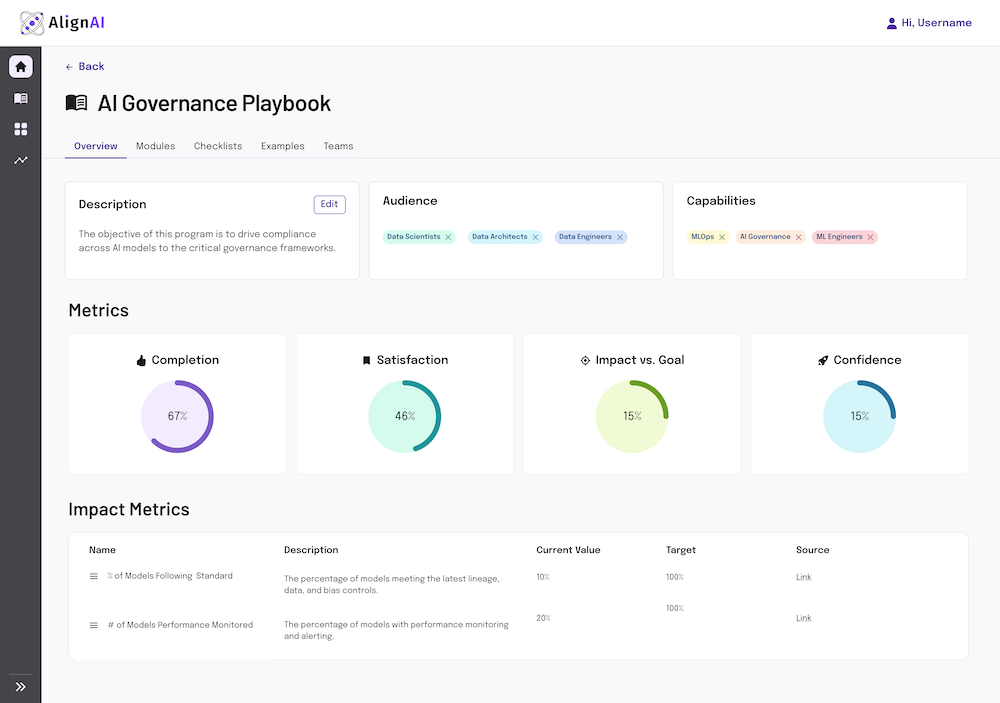
AlignAI provides structured intake, review and visibility for enterprise AI programs. Its published bank case describes an unnamed top-10 U.S. bank replacing fragmented tracking with one platform. The practical value is a clearer view of initiatives, their review status and the decisions needed to move them forward.
Could you brief your CEO on every AI initiative in your company right now?
When leadership asks what the AI program is delivering, what takes the most work to answer? Send me a little context, and we can look at whether AlignAI would help.
Can you see which AI initiatives should move, stop, or compound together?