by

Jason Hauer

Škoda built a bike bell that beats noise-cancelling headphones.

A near-miss on a London street became Škoda's smartest marketing spend in years. The bigger idea: someone else's AI has broken something in your category too, and fixing it might be your next growth play.

Serial Growth Lab

Thought Leadership

Škoda

A near-miss on a London street became Škoda's smartest marketing spend in years. The bigger idea: someone else's AI has broken something in your category too, and fixing it might be your next growth play.

Ben Fraser was walking to work near Borough Market, headphones on, when a cyclist nearly hit him. The cyclist had been ringing his bell the whole way down the street. Fraser never heard a thing.

Fraser works at PHD Media, and the near-miss became a brief. Transport for London data showed bike-pedestrian collisions rose 24% in 2024, with cyclists set to outnumber car drivers in London for the first time this year. One quiet contributor: active noise cancellation. The bike bell had worked for a century. On a growing share of pedestrians, it simply stopped working, because an algorithm in their headphones was scrubbing it out of the air.

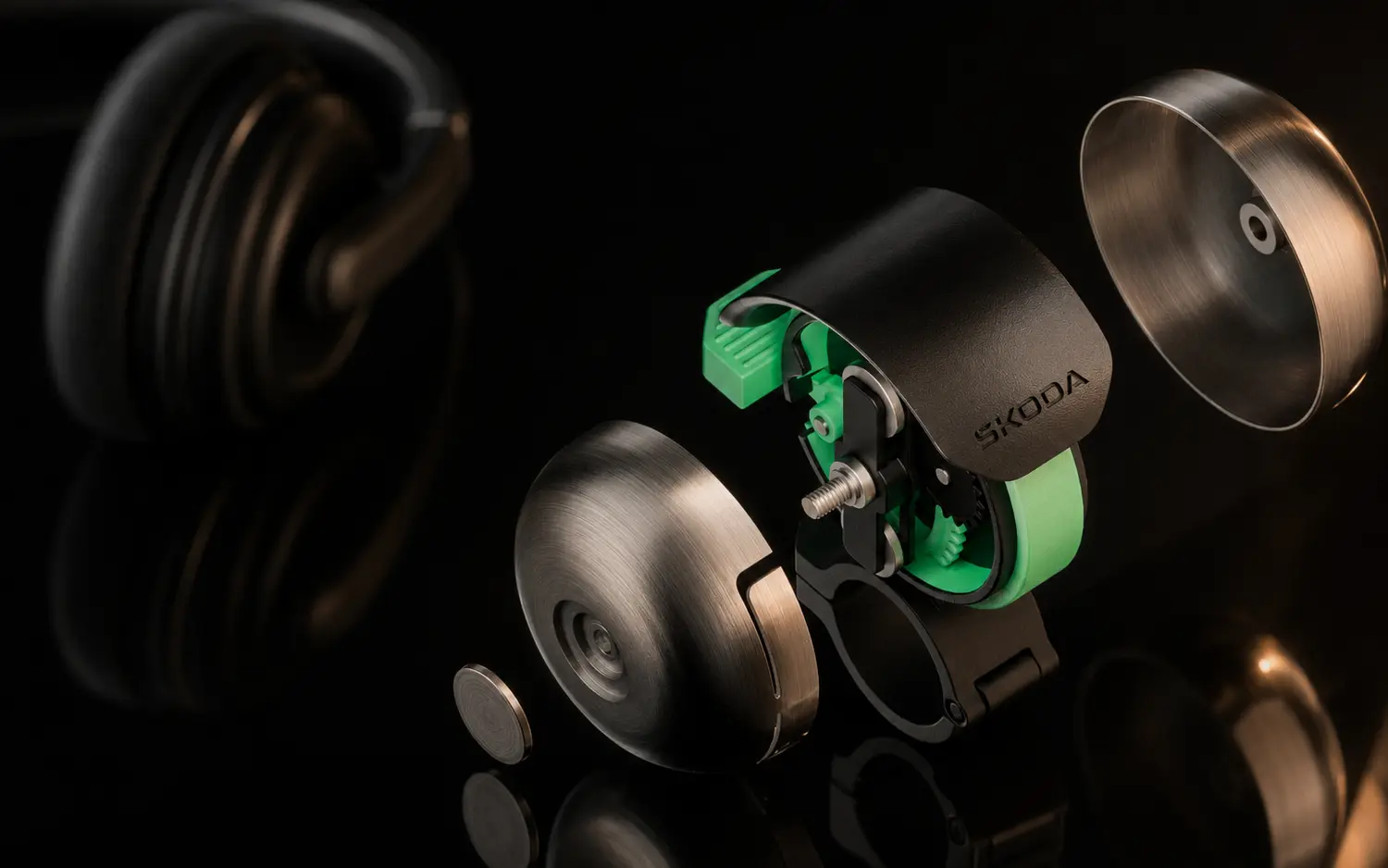
Škoda, the Czech carmaker owned by Volkswagen Group and one of Europe's biggest auto brands, took the problem to acoustics researchers at the University of Salford. Testing turned up something useful: noise-cancelling algorithms struggle with a narrow band between 750 and 780 hertz. So Škoda built the DuoBell, a second resonator tuned to that gap, plus a hammer that strikes in an irregular rhythm the algorithms can't predict. Fully mechanical. A piece of metal designed to beat software.

They tested it with a fleet of Deliveroo riders in London, people whose income depends on being heard in traffic. One rider said that with the bell, he finally had a voice in the streets. The riders wanted to keep them.

Pedestrians in noise-cancelling headphones gained up to five extra seconds of reaction time and up to 22 metres of additional distance. Roughly four times the cut-through of a standard bell. Škoda published the underlying research as an open-source white paper, and the work took Silver in Creative Data at Cannes in June. One case-study breakdown projects €79 million in vehicle sales connected to the project, which fits how the company sees it. Škoda started life as a bicycle maker in 1895 and still sponsors the Tour de France. The fix sits inside a hundred-year-old brand truth.

The gap in your category is somebody's data right now

Nobody at the headphone companies set out to make cyclists invisible. Noise cancellation was a good product decision that quietly broke a safety system in a completely different category, and the breakage sat unowned for years while collisions climbed. That pattern is everywhere now. Every AI deployment of the last three years created some downstream effect in somebody else's business.

Somebody is absorbing that cost right now, and no line item owns it.

Look at your own category through that lens. A century-old bell stopped working because ears started running software. Every signal your company sends was built the same way, for a human on the receiving end, and a machine now sits between you and that person. Your buyer's first impression of you is written by a model you've never briefed. Everything you send after that runs through software tuned by companies with no stake in whether you're heard. Somewhere in that chain, something that worked in your category for decades is being scrubbed out of the air, and the loss surfaces in a metric you've been explaining some other way. The collision numbers sat in Transport for London's data before anyone thought to blame headphones. Your version of that number already exists. It's in a dashboard right now, filed under something else.

Škoda's move was to treat the breakage as a market. Find the gap, spend the budget on fixing it, and let the fix carry the brand. The bell exists because someone measured a frequency nobody had bothered to look for.

By the numbers

24%. Rise in bike-pedestrian collisions in London in 2024.

5 seconds. Of extra reaction time for pedestrians in noise-cancelling headphones.

22 metres. Of additional reaction distance.

4x. More effective than a standard bell at cutting through.

Transport for London data · University of Salford acoustic testing · Škoda disclosures

What to do this week

The first conversation moved. Your customer now asks a model before they ask you, whether that's a buyer building a shortlist or a client second-guessing your advice. This week, put your customers' most common questions to the major models, worded the way they'd word them. What comes back is your new first impression.

The unfiltered channels are still open. Every digital signal you send now clears someone else's software before a human sees it. Nothing stands between a room and the people in it. Škoda answered an algorithm with a piece of metal; your equivalent might be a dinner, or a printed report that lives on a desk for a month. Pick the one message this quarter that can't survive being flattened and spend real money delivering it by hand.

The next breakage is already in somebody's data. The collision numbers sat in Transport for London's files before anyone blamed headphones. Spend an hour with your team on two questions. What have our own AI deployments broken for the people downstream, the customer who needed a person, the partner whose emails our triage now buries? And what's degrading in our category that nobody has claimed yet? One of those answers is a liability you can still price before a competitor does. The other is a bell nobody has built.

Whatever you find, take it all the way to metal. Škoda could have stopped at the white paper. The bell is the reason you're reading about them.

From the portfolio

Turning breakage into a product, a service, or a reason to buy is value-creation work, and it's exactly what Board of Innovation does with enterprises: finding where the ground has shifted and building the business model that meets it. If that's what you're working through right now, reach out and I'll connect you.

Their summit is where this thinking runs at full scale. AUTONOMOUS, Sept 9 and 10, fully virtual, about 15,000 leaders expected. Most sessions are client-led, with brands like Walmart, Coca-Cola, PepsiCo, and IKEA on stage sharing what's working mid-transformation. I'll be there both days. Register at autonomoussummit.ai, and let me know if you're attending so we can compare notes.

A century-old bell needed one new frequency to work again. Your category has a gap like that somewhere.

What's quietly stopped working in your category?

Talk Tuesday,

Jason Hauer
Founder & CEO, HauerX Holdings
jason@hauerX.com

Jason Hauer is the founder and CEO of HauerX Holdings, where he backs and builds a portfolio of AI-native companies that accelerate how businesses grow, operate, and compete. From mid-market to Fortune 500.

Frequently Asked Questions

What is the Škoda DuoBell?

A fully mechanical bicycle bell designed to beat active noise-cancelling headphones. It uses a second resonator tuned to a narrow frequency band (750-780 Hz) that noise-cancelling algorithms struggle with, plus a hammer that strikes in an irregular rhythm the algorithms can't predict. Roughly four times the cut-through of a standard bell.

Why did Škoda build the DuoBell?

Transport for London data showed bike-pedestrian collisions rose 24% in 2024, with cyclists set to outnumber car drivers in London for the first time this year. A quiet contributor was active noise cancellation in headphones, which was scrubbing bike bells out of the air. Škoda, which started life as a bicycle maker in 1895 and still sponsors the Tour de France, treated the breakage as a market.

What did the DuoBell measurably do for pedestrian safety?

Pedestrians in noise-cancelling headphones gained up to five extra seconds of reaction time and up to 22 metres of additional distance. Škoda tested it with Deliveroo riders in London, people whose income depends on being heard in traffic. One rider said that with the bell, he finally had a voice in the streets. Škoda published the underlying research as an open-source white paper and took Silver in Creative Data at Cannes 2026.

What's the bigger lesson for other brands?

Every AI deployment of the last three years created some downstream effect in somebody else's business. That collision numbers sat in Transport for London's data before anyone thought to blame headphones. Your version of that number already exists, in a dashboard right now, filed under something else. Škoda's move was to treat the breakage as a market: find the gap, spend the budget on fixing it, and let the fix carry the brand.

How do I find the "bell" in my own category?

Spend an hour with your team on two questions. What have our own AI deployments broken for the people downstream, the customer who needed a person, the partner whose emails our triage now buries? And what's degrading in our category that nobody has claimed yet? One of those answers is a liability you can still price before a competitor does. The other is a bell nobody has built. Whatever you find, take it all the way to metal.