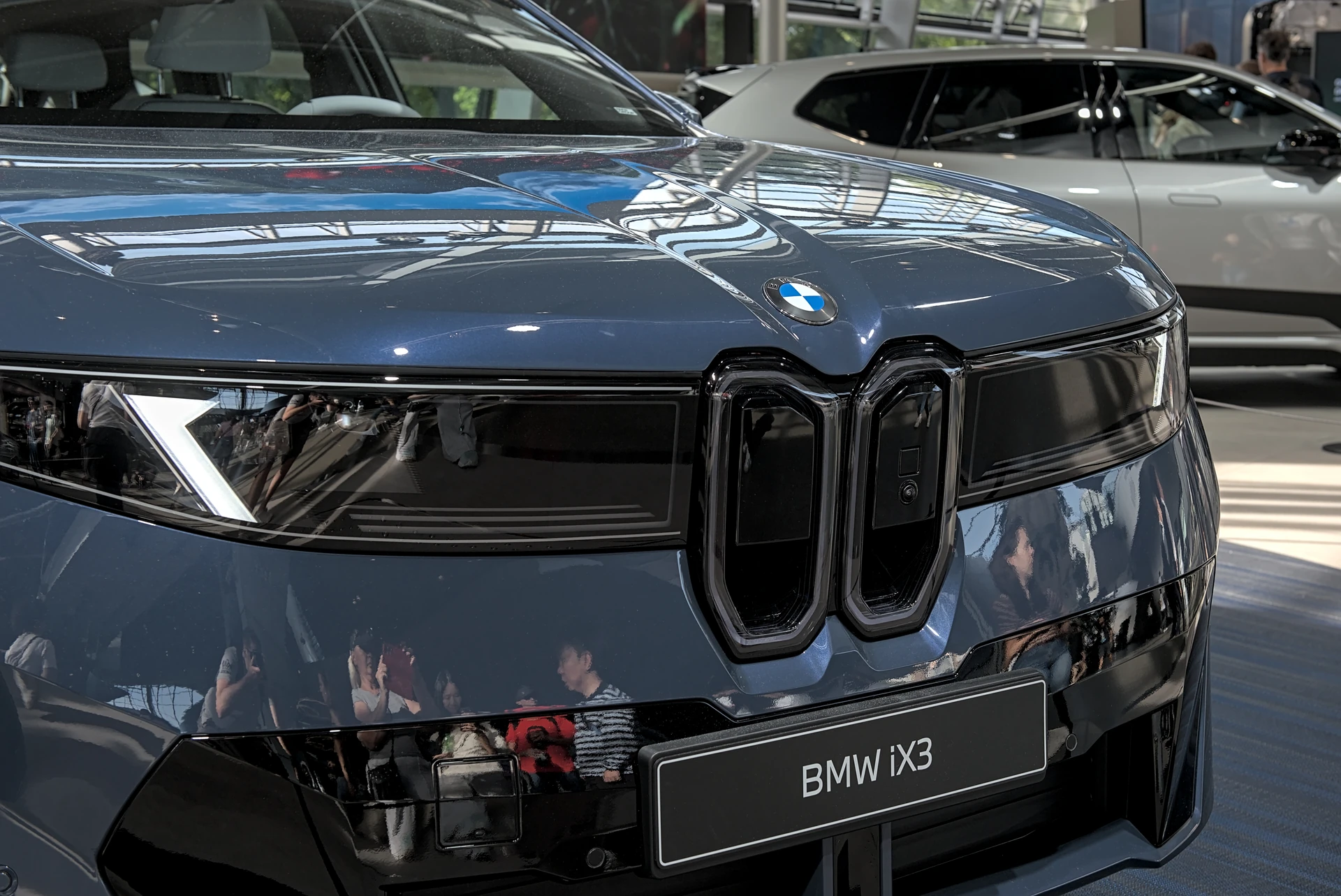
Samsung's new robot vacuum doesn't tell you it's using computer vision. It just cleans coffee spills differently than dog hair. BMW's voice assistant doesn't mention it's running Amazon's most advanced language model. You talk to your car and it talks back like a person who happens to control your climate and know your calendar.
This is the moment consumer AI became invisible. And that invisibility is exactly what makes it competitively lethal.
Samsung rebuilt home appliances around computer vision. BMW made conversational AI standard equipment. Target and Walmart deployed shopping agents that complete purchases autonomously. Papa Johns launched unified voice ordering across every channel. L'Oréal won CES awards for AI-powered skincare devices.
Not pilots. Not experiments. Category redefinitions.
The strategic implications extend far beyond consumer products. These launches reveal exactly where AI creates durable competitive advantage versus where it generates temporary attention. The patterns transfer to healthcare, financial services, B2B, and every sector watching from the sidelines.
The companies that moved are now accumulating data, refining models, and compounding advantages. The opportunity for everyone else: learn from what worked and move faster.
The Strategic Shift: From Feature to Foundation
The most important pattern in this wave of launches isn't what shipped. It's how it shipped.
These products don't announce their intelligence. They demonstrate it through better outcomes. This represents a fundamental shift in product strategy. The winners aren't adding AI capabilities to existing products. They're rebuilding products around intelligence as foundational infrastructure.
The distinction matters enormously for competitive positioning. AI-as-feature invites comparison. AI-as-foundation creates category separation. When intelligence is invisible but the value is obvious, competitors cannot easily replicate the advantage because there's no discrete feature to copy.
Every enterprise leader should be asking: are we adding AI to our products, or rebuilding our products around AI? The companies in this wave chose the latter. Their competitors now face a structural disadvantage.
Home Intelligence: Proactive Products That Anticipate
Samsung and LG both unveiled comprehensive AI appliance ecosystems at CES 2026. The consumer value proposition is straightforward: appliances that understand context and optimize automatically. The strategic value proposition is more significant: ecosystem lock-in that transforms one-time purchases into platform relationships.
Samsung's Bespoke AI Jet Bot Steam Ultra uses StainTarget AI to distinguish wet messes from dry debris through computer vision, deciding whether to mop or vacuum each spot. It recognizes humans, pets, and over 200 obstacle types. Safety Patrol mode monitors the home when residents are away.
Their new laundry system detects fabric type automatically, adjusting water levels, detergent amounts, and drying time without user input. The AI monitors soil levels in real-time, optimizing for each load.
Jeong Seung Moon, EVP of R&D at Samsung's Digital Appliances: "Through our continuous innovation, we are elevating how users interact with their appliances on a day-to-day basis."
LG unveiled CLOiD, a home robot with two arms and five-fingered hands capable of retrieving items from refrigerators, loading ovens, folding laundry, and monitoring elderly family members. Not yet consumer-available, but it signals strategic direction.
The business model shift: These products generate continuous data about household behavior, preferences, and patterns. Samsung's AI refrigerator knowing your food inventory enables its TV to suggest recipes using available ingredients. The ecosystem becomes more valuable as it learns, creating switching costs that discrete appliances never could.
The competitive implication: Appliance manufacturers without AI infrastructure are now selling commodities against platforms. The price premium Samsung and LG can command will expand as the intelligence gap widens.
Strategic transfer for every industry: The breakthrough here is proactive intelligence. These appliances don't wait for commands. They sense context and act. Where does this pattern apply in your business?
Healthcare systems could monitor patient vitals and intervene before symptoms escalate. Financial services could detect cash flow patterns and offer solutions before clients ask. B2B platforms could identify customer friction and resolve issues before support tickets arrive. Insurance providers could spot risk patterns and recommend mitigation proactively.
The question for every enterprise: where are your customers currently forced to notice problems and request solutions? That's where proactive AI creates the most value and the deepest loyalty.
Automotive: Conversation as Brand Experience
BMW's integration of Amazon Alexa+ makes them the first automaker to deploy Amazon's LLM-powered conversational AI. Mercedes debuted urban autonomous driving. Tesla integrated Grok. Rivian shipped a contextual assistant free to existing owners.
The consumer value: cars that understand natural language and context, not just commands. BMW's system maintains conversational context for approximately an hour. Drivers can say "I'm cold and hungry for pizza" and receive a combined response. Preferences save to long-term memory across sessions.
Stephan Durach, BMW Group Senior Vice President: "With the addition of Amazon's Alexa+ technology to the BMW Intelligent Personal Assistant, the vehicle becomes an intelligent companion for its users."
Mercedes' MB.DRIVE ASSIST PRO handles urban environments for the first time. Traffic lights, stop signs, complex intersections. The system generates 10 possible outcomes for each control decision, executing when 8 of 10 scenarios agree. Car and Driver tested it in San Francisco: 35 minutes in Bay Area traffic without a single required intervention.
Rivian's Assistant handles requests like "Make everyone's seat toasty except mine" or texts your ETA to contacts while navigating. Developed in-house using Google Gemini and rolling free to all existing R1T and R1S owners.
The brand differentiation play: Automotive AI is becoming the primary interface between driver and vehicle. The quality of that conversation now defines the ownership experience. BMW and Mercedes are betting that conversational sophistication becomes a luxury differentiator on par with interior materials and driving dynamics.
The competitive implication: Every automaker will eventually have conversational AI. The advantage goes to those who ship first and accumulate interaction data. BMW's system will improve with every conversation across their fleet. Competitors entering late start with inferior models and smaller training sets. The gap compounds.
Strategic transfer for every industry: The insight here is that conversation quality has become brand quality. The AI voice IS the brand voice now.
This applies immediately to any company with high-frequency customer interactions. Banks and insurers: every call, chat, and inquiry is now a brand moment that AI either elevates or diminishes. Hospitality: the concierge experience scales through AI that remembers preferences and anticipates needs. Professional services: client communication becomes a differentiator when AI handles routine interactions with the same care as senior partners.
The question for every enterprise: if your customers judged your brand entirely by the quality of AI interactions, would you win or lose?
Retail: Capturing Demand at the Moment of Intent
The most consequential announcement came at NRF in January, where Google unveiled the Universal Commerce Protocol, a new open standard co-developed with Target, Walmart, Shopify, and Etsy that enables AI agents to browse, compare, and complete purchases across retailers.
This isn't AI that helps consumers shop. This is AI that shops for consumers.
Target announced integration with both ChatGPT and Google Gemini. Shoppers describe what they want in natural language and receive curated product selections with direct checkout. 25% of Target customer searches are now conversational rather than keyword-based.
Prat Vemana, Target's Chief Information and Product Officer: "We're proud to be one of the first retailers bringing shopping into this new channel."
Walmart's Sparky AI creates curated shopping lists, generates audio clips summarizing product reviews, and powers digital showrooms where customers visualize products against immersive backdrops. The data: shoppers using AI tools spend 25% more on average.
Tracy Poulliot, SVP of Shopping Experiences at Walmart: "Customers are really starting to rely on these GenAI assistants to take on more of a problem-solving approach than your traditional item-by-item search experience."
Amazon's Rufus AI continues expanding. Shoppers who use it are 60% more likely to complete purchases. Amazon expects Rufus to generate over $10 billion in annual sales.
Lowe's Mylow Virtual Advisor represents the first AI-powered home improvement assistant. Open-ended questions like "How do I fix a leaky faucet?" return step-by-step guidance with linked products.
The business model transformation: Retail AI isn't about efficiency. It's about capturing demand at the moment of intent. When a consumer tells an AI assistant they need to "plan a holiday movie night," the retailer whose AI responds first with curated products and frictionless checkout wins that basket. Every competitor who requires the consumer to search, browse, and assemble manually loses.
The competitive implication: The retailers deploying conversational commerce are building moats. They're training AI on purchase behavior, preference patterns, and intent signals. Late entrants will face AI assistants that already know what consumers want. The 25% higher basket sizes aren't a feature benefit. They're a compounding advantage.
Strategic transfer for every industry: The pattern here is solving problems, not selling products. Walmart's insight that customers want "problem-solving" rather than "item-by-item search" applies far beyond retail.
Financial advisors: what if AI understood client goals and assembled solutions rather than presenting product options? Healthcare: what if AI helped patients navigate wellness rather than scheduling appointments?
The question for every enterprise: are you selling products or solving problems? The companies capturing demand at moment of intent chose the latter.
QSR: Speed and Accuracy as Unit Economics
Papa Johns announced the industry's first fully unified voice and text AI ordering system at NRF, becoming the first restaurant partner for Google Cloud's Food Ordering agent. An "Intelligent Deal Wizard" automatically applies optimal value combinations. Complex multi-person orders resolve through natural language. Loyalty customers reorder instantly.
Kevin Vasconi, Chief Digital Officer: "This isn't just an app update; it's a fundamental shift in how our customers interact with our brand digitally."
Wendy's FreshAI drive-thru has expanded to 500-600 locations. 86% order accuracy without human intervention. 22-second reductions in average wait times. The system understands casual conversation and regional accents while handling over 200 billion customization options.
McDonald's is rebooting its AI drive-thru program with Google Cloud after ending its IBM partnership. Computer vision for order verification. AI-powered menu boards that adapt based on time, weather, and local events.
Starbucks' Green Dot Assist gives baristas generative AI via iPad for instant recipe information and troubleshooting. AI-powered inventory counting reduces time from 1 hour to under 15 minutes.
The consumer value proposition: Speed and accuracy without friction. Wendy's 22-second improvement represents millions of cumulative hours returned to customers annually. Order accuracy at 86% without human intervention eliminates the frustration that drives customers to competitors.
The competitive implication: QSR operates on thin margins where throughput determines profitability. AI that accelerates ordering while improving accuracy directly impacts unit economics. The chains deploying these systems generate more revenue per location with lower labor costs. Competitors without AI ordering will compete at a structural disadvantage on both customer experience and operating margin.
Strategic transfer for every industry: The insight here is that speed and accuracy compound into margin advantage. Any business with transaction volume should be examining where AI can simultaneously improve customer experience and unit economics.
Healthcare systems: patient intake, scheduling, and discharge processes all have the same characteristics as drive-thru ordering. Speed matters. Accuracy matters. Both impact economics. Logistics and fulfillment: every touchpoint from order to delivery benefits from the same optimization. Financial services: transaction processing, claims handling, and account servicing all follow the pattern.
The question for every enterprise: where do speed and accuracy constraints currently limit your throughput and margins? That's where AI investment generates the fastest returns.
Beauty and Health: Personalization Finally Delivered
Beauty tech emerged as a standout CES 2026 category. Kolmar Korea won the first-ever Best of Innovation Award in Beauty Tech for an AI Scar Beauty Device that classifies scars into 12 types via smartphone photo, then dispenses customized treatment while spray-matching from 180+ skin tones.
L'Oréal announced two CES Innovation Award-winning devices: an AI-powered LED Face Mask that adapts treatment protocols based on individual skin analysis, and the Light Straight+ Multi-styler with embedded sensors that adapt to user movements.
Amorepacific debuted Skinsight, a sensor platform co-developed with MIT that uses patches to measure aging factors and generate personalized care recommendations in real-time.
Peloton IQ continues gaining traction after its October 2025 launch. AI coaching analyzes workout history and wearable data, provides real-time form feedback via movement-tracking cameras, creates adaptive weekly plans.
Nick Caldwell, Peloton Chief Product Officer: "We have six million members, and using AI, we can offer every one of those members a one-to-one relationship."
The brand differentiation play: Beauty and fitness have always promised personalization. AI finally delivers it at scale. L'Oréal's devices don't just apply treatment. They analyze, adapt, and optimize for individual skin. Peloton's AI doesn't just count reps. It corrects form, adjusts difficulty, and evolves with the user.
The competitive implication: Generic products now compete against AI-personalized alternatives. The brands embedding intelligence into beauty and fitness devices are creating value propositions that commodity competitors cannot match. A face mask that adapts to your skin competes in a different category than a face mask that doesn't.
Strategic transfer for every industry: The breakthrough here is that AI finally makes one-to-one relationships scalable. Every industry that promised personalization but couldn't deliver at scale now can.
Wealth management: true personalized advice was only economical for high-net-worth clients. AI changes that math entirely. Education: adaptive learning that responds to individual student needs becomes possible at every price point. B2B services: customized solutions that previously required senior partner attention can now be delivered across the client base.
The question for every enterprise: where have you promised personalization but delivered segmentation? AI closes that gap. The companies that close it first will capture the customers who always wanted what you promised.
Entertainment: Anticipation as Interface
Samsung's Micro RGB 130" TV won the CES 2026 Best of Innovation Award partly for its Vision AI Companion. The system understands what viewers watch and surfaces contextual information through voice commands. Soccer Mode Pro improves picture quality while optionally muting commentators but keeping ambient stadium sounds.
LG's OLED evo W6 features the α11 AI Processor Gen3, running 5.6x faster than previous generations with AI Search, AI Concierge, and Voice ID that recognizes individual users for personalized dashboards.
Google TV's Gemini AI enables commands like "the screen is too dim" or "I can't hear the dialogue" to adjust settings, along with series recaps, image editing, and natural language photo searches.
Amazon's Fire TV redesign achieved 30% faster navigation with Alexa+ integration. Users engage 2x more in conversations, make 3x more purchases, and submit 5x more recipe requests compared to prior Alexa.
The consumer value proposition: Entertainment AI anticipates needs rather than responding to commands. Voice ID recognizes who's watching and adjusts recommendations. Picture optimization happens automatically based on content type. The interface disappears.
The business model shift: Smart TVs are becoming commerce and services platforms. Amazon's 3x purchase increase through Fire TV represents a new revenue channel. The television evolves from hardware sale to ongoing monetization opportunity.
Strategic transfer for every industry: The pattern here is that AI learns usage patterns and anticipates needs before users express them. This transforms any repeat-engagement business.
Subscription services: AI that understands consumption patterns can surface the right content, product, or feature before customers search. SaaS platforms: AI that recognizes workflow patterns can offer relevant capabilities before users navigate to find them. Membership organizations: AI that tracks engagement patterns can deliver value proactively rather than waiting for members to request it.
The question for every enterprise: what do you know about customer behavior that you're not using to anticipate their needs? That knowledge becomes a competitive weapon when AI operationalizes it.
What This Evidence Reveals
Three strategic patterns emerge from this wave that every leader should internalize.
Ecosystem integration creates compounding value. Samsung's AI refrigerator knowing your food inventory enables its TV to suggest recipes using available ingredients. BMW's assistant continuing conversations started with home Alexa devices. The value multiplies across connected products. Standalone AI features cannot compete against integrated AI ecosystems. The companies building platforms will outcompete those adding features indefinitely.
Voice plus vision is the new interface standard. Nearly every major launch combines conversational AI with computer vision. Vacuums that see and decide. Cars that hear and respond. TVs that watch what you watch. This multimodal approach delivers on decades of smart home promises because the technology finally works reliably. Companies investing in single-modality AI are already building yesterday's products.
Embedded value defeats extracted subscriptions. Luna Band positions against Whoop without subscription fees. Papa Johns' AI ordering requires no premium tier. Tesla and Rivian ship assistant updates free. Consumer tolerance for AI-as-service has limits. The companies embedding AI into product value rather than extracting it through recurring fees are winning customer preference and market share.
The Advantage Compounds From Here
BMW's first Alexa+ car. Google's Universal Commerce Protocol. Papa Johns' unified ordering AI. L'Oréal's award-winning beauty devices. Samsung's AI appliance ecosystem. All shipped in weeks.
Consumer AI has moved from experimental to expected. The companies that built and deployed are now accumulating data, refining models, and pulling ahead with every customer interaction.
The strategic question for every enterprise leader is no longer whether to deploy AI. It's whether you're building AI-native products that create structural advantages, or adding AI features that generate temporary differentiation.
The evidence is unambiguous. The companies that rebuilt products around intelligence are separating from the pack. The companies that bolted AI onto existing products are watching that separation accelerate.
The leaders moved. The opportunity is learning from them and moving faster.
Speed to signal. Speed to market. Speed compounds.
Jason Hauer is CEO and Founder of HauerX Holdings, a portfolio company that backs and builds AI-native enterprises.