I was meeting recently with a CEO who runs a large, successful organization. Thousands of employees. Decades of market leadership. The kind of company that sets the pace for its category.
He gets it. He sees what AI makes possible. He has a handful of people on his team who have leaned hard into the moment, and he spotlights them constantly to show the rest of the organization what's achievable.
Then he said the thing that every honest leader is thinking but almost nobody will say out loud:
"How long do I give the people who have every opportunity to lean in, but won't?"
It's the right question. But I think it's the second question. The first one is harder, and most leaders haven't answered it yet.
And the reason it's urgent is something I don't think most leaders have fully internalized yet: the capability isn't incremental anymore. It's compounding. The tools I'm using today are meaningfully better than what I was using three months ago, and three months from now they'll be exponentially better again. Every month the gap widens between what's possible and what most organizations are doing. This isn't a trend you can monitor from a distance and catch up to when you're ready. The distance between "started now" and "started in six months" isn't six months. It's six months of compounding capability that you missed and your competitors didn't.
Which makes the first question even more important:
Have you shown them what the company becomes?
"Lean into AI" isn't a vision. "Get more efficient" isn't a vision. "Adopt these tools" isn't a vision.
A vision is: here's what this company becomes. Here's where value creation moves. Here's how every function fits. Here's why it's better for the business, for our customers, and for you.
If your people can't see themselves in the future you're building, the problem isn't their resistance. It's your clarity.
The Question Most Leaders Haven't Asked
When production costs collapse across every knowledge work function, the shape of your company changes. Not incrementally. Structurally.
The CPG company that thinks it sells products needs to see that it's becoming a demand intelligence company that happens to make products. The value isn't in the formulation or the package. It's in knowing what to make, for whom, and when, faster than anyone else in the category.
The consulting firm that sells expertise by the hour needs to see that it's becoming a specification platform that happens to employ consultants. The value isn't in the deliverable. It's in the precision of the brief that produces it.
The manufacturer that sells physical goods needs to see that it's becoming an integration layer between intelligence systems and physical production. The value isn't in the factory. It's in the speed from signal to shelf.
Every business is becoming a software business, an intelligence business, an integration business. The product is still real. The service is still real. But the value is migrating to the system around it. To the speed of the loop. To the precision of the specification. To the compounding intelligence that gets smarter with every cycle.
Most leaders haven't articulated this for their companies yet. They've said "we need to be AI-first" without answering the question their best people are actually asking: What does that mean for us, specifically? What do we become?
Without that answer, "lean into AI" is just a directive to adopt tools. And tool adoption, as I've covered, is the horizontal layer. It's necessary. It creates no competitive advantage. It's the starting line dressed up as the destination.
Why the Vision Stalls
If you haven't painted this picture yet, you're not alone. And the reason isn't that you can't see it. It's that the picture is complicated by people you respect.
The moment you articulate what the company becomes, you're implicitly telling people what their role becomes. The VP who built the research function. The leader who designed the process everyone follows. The executive whose instinct has been the strategy for a decade. These are your most experienced, most loyal, most trusted people. They built what works today. And the vision of what the company becomes asks them to reimagine the thing that made them successful.
That's a genuinely hard conversation to initiate. So most of us soften it. We say "AI-enhanced" when we mean "AI-native." We say "augment your team" when we mean "redesign your function." We say "evolve" when we mean "transform." The language is gentle because we know what the implication means for people we care about.
But here's what I've learned: the gentleness doesn't protect them. It stalls them. When the vision is vague, people fill the gap with their own interpretation. And that interpretation will always protect the current state, because the current state is where their identity lives. The kindest thing you can do is be clear. Not harsh. Clear. Clear enough that your best people can see where they fit in what's coming, and start building toward it instead of defending against it.
And if you're wondering what the cost of that vagueness looks like on the other side, here's what most employees won't say to you directly: "I'm not resisting AI. I'm trying to figure out what my job is in 18 months and nobody will tell me. Every town hall says AI won't replace me, but everything I'm seeing says my role is changing, and no one has described what I'm changing into." That silence doesn't show up as resistance. It shows up as hesitation, as safe choices, as people protecting what they know because nobody has made what's next feel real enough to move toward.
The CEO who asks "how long do I give my people?" has it backwards.
The question isn't how long you give them. It's how clearly you've shown them where you're going. Have you described what the company becomes? Have you explained where value creation moves? Have you helped each function see what it looks like on the other side?
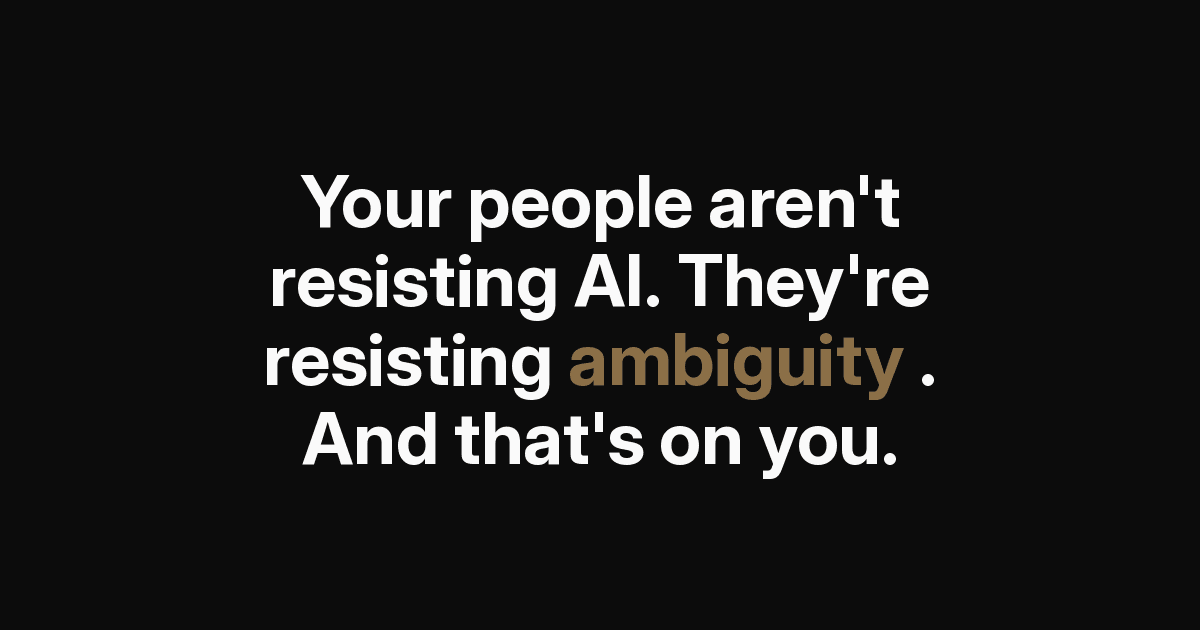
If you haven't, your people aren't resisting change. They're resisting ambiguity. And that's on you.
The Three Things Your People Need From You
But before any of this works, you have to do something uncomfortable: you have to go learn.
You can't describe the destination if you haven't visited it. One of the most accomplished founders in marketing technology, someone who built and scaled a platform used by thousands of companies, recently joined a small private group I'm part of. He's not there to teach. He's there to learn. To sit at the edge of what's happening with AI, alongside people who are building in it every day, because he knows the landscape is moving too fast to observe from a distance.
That's what it takes. Not delegating "the AI stuff" to a team. Not reading a summary from your chief of staff. Putting yourself in rooms where the future is being built, being a student again, doing the work yourself so that when you paint the picture for your organization, it's grounded in firsthand experience, not secondhand abstraction.
Once you've done that, the leader's job shifts from persuasion to architecture. You don't need to convince people AI matters. You need to build the structure that lets them find their place in what's coming.
First, define the destination in terms they can see themselves in. Not "we're becoming AI-native" but "here's what your function looks like when it's 10x faster, 10x more integrated, 10x more responsive. Here's what you're responsible for. Here's what the system handles. Here's where your judgment becomes more important, not less." The VP of Insights doesn't need to hear that her team is shrinking. She needs to hear that the company's intelligence capability is expanding, and she's the person who defines what questions the system answers and whether the answers are good enough to act on. That's a bigger job, not a smaller one. But she needs to see it described specifically enough to believe it.
Second, build the experimentation architecture. You can't ask people to leap to the destination. You have to give them a way to test their way there. Small bets. Fast cycles. Permission to fail at low cost. The specification economy rewards speed of learning, not perfection of planning. The leader who says "run three experiments this quarter and tell me what you learned" is creating conditions for agency. The leader who says "build me an AI strategy" is creating conditions for paralysis. Experimentation is how people discover their new value. You can't tell someone their instinct is now a specification skill. They have to feel it by running an experiment where precise specification produced a dramatically better result than vague direction.
Third, compress the feedback loop. Quarterly reviews were designed for a world where production took months. When production takes minutes, the learning cycle needs to match. Weekly check-ins on what's working. Monthly resets on what's not. Kill things fast. Redirect faster. The organizations pulling away aren't smarter. They're faster at learning and faster at discarding what doesn't work. That speed is a leadership decision, not a technology decision. If your operating rhythm still runs on quarterly planning and annual reviews, you've built a governance structure for a company that no longer exists.
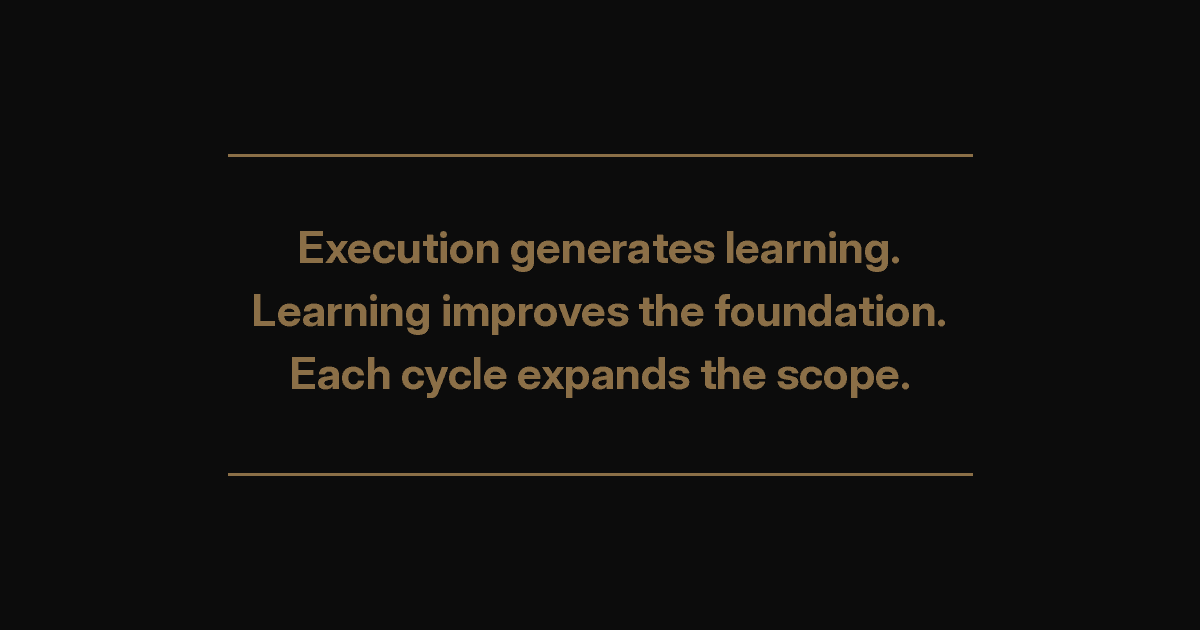
Vision: What does the company become? Not "AI-first." Specifically.
Experimentation: Small bets. Fast cycles. Let people discover their new value.
Speed: Weekly learning. Monthly resets. Kill fast. Redirect faster.
Then, and Only Then, the Evaluation
Once you've done that work, once you've painted the picture, built the experimentation structure, and compressed the feedback loop, then you can evaluate your people honestly.
And the evaluation is simple. Not "have they adopted AI" but "are they curious or defensive?" A senior leader who's struggling with the transition but actively engaging with it, running experiments, asking hard questions, rethinking assumptions, is in a fundamentally different position than a senior leader who checked the training box and went back to running her function the way she ran it in 2023.
The first leader needs time and support. The second leader needs a direct conversation. Not because you're ruthless, but because protecting someone from the reality of this shift isn't kindness. It's setting them up for a harder fall later.
That's the compassionate case for urgency. Be radically clear about where value is moving. Create every condition for people to make the transition. Give them a vision worth moving toward, a structure to experiment within, and a pace that matches the moment. Then hold them accountable to meeting it.
But if you haven't done that work first, the dilemma isn't theirs. It's yours.
What To Do THIS WEEK
Finish this sentence for your company: "When AI is native to every function, we become a ___________________ company that happens to ___________________."
If you can't complete it with conviction, that's the work. Not another AI pilot. Not another adoption dashboard. The strategic imagination of what your company becomes when production costs approach zero in every knowledge work function.
Your people are waiting for that answer. The best ones will run toward it. But they need to see it first.
From The Portfolio
Board of Innovation helps enterprise leadership teams answer the "what do we become?" question and then build the AI-native systems to get there. Their work with companies like Walmart and Coca-Cola isn't about deploying tools. It's about redesigning how an entire function creates value. Learn more →
Your people aren't the obstacle. They're waiting for a destination worth running toward.
If you're building that picture, I'd love to hear what you're wrestling with: jason@hauerx.com
Jason Hauer is the founder and CEO of HauerX Holdings, where he backs and builds a portfolio of AI-native companies that accelerate how businesses grow, operate, and compete. From mid-market to Fortune 500.
Frequently Asked Questions
Why are your people resisting AI ambiguity, not AI itself?
People aren't resisting AI. They're trying to figure out what their job is in 18 months when nobody has told them. Every town hall says AI won't replace them, but everything they're seeing says their role is changing, and no one has described what it's changing into. That silence shows up as hesitation, safe choices, and people protecting what they know because nobody has made what's next feel real enough to move toward. If you haven't shown them where you're going, they aren't resisting change. They're resisting ambiguity. That's on the leader.
What does 'have you shown them what the company becomes?' actually mean?
"Lean into AI" isn't a vision. "Get more efficient" isn't a vision. "Adopt these tools" isn't a vision. A vision is: here's what this company becomes. Here's where value creation moves. Here's how every function fits. Here's why it's better for the business, for customers, and for the people who work here. Every business is becoming a software business, an intelligence business, an integration business. Most leaders haven't articulated that for their company yet.
What are the three things people need from a leader before they'll move on AI?
Vision: a destination defined in terms each function can see itself in, not "we're becoming AI-native" but "here's what your function looks like when it's 10x faster, 10x more integrated." Experimentation architecture: small bets, fast cycles, permission to fail at low cost. Compressed feedback loops: weekly check-ins on what's working, monthly resets on what's not, kill things fast, redirect faster. Without all three, AI strategy becomes paralysis.
Why does softening the AI vision actually stall your best people?
When the vision is vague, people fill the gap with their own interpretation. And that interpretation will always protect the current state, because the current state is where their identity lives. Most leaders soften the conversation because they're protecting people they respect: the VP who built the research function, the executive whose instinct has been the strategy for a decade. The gentleness doesn't protect them. It stalls them. The kindest thing you can do is be clear.
How should leaders evaluate people honestly during AI transformation?
Once you've painted the picture, built the experimentation architecture, and compressed the feedback loop, evaluate people on one thing: are they curious or defensive? A senior leader struggling with the transition but actively engaging with it (running experiments, asking hard questions, rethinking assumptions) is in a fundamentally different position than one who checked the training box and went back to running her function the way she ran it in 2023. The first needs time. The second needs a direct conversation.