I spend a lot of time with R&D and innovation leaders at large enterprises. The ones running open innovation programs, managing external research partnerships, scouting emerging technologies. These are some of the sharpest people in their organizations.
But here is what I keep hearing, especially from leaders at CPG, chemicals, life sciences, and advanced manufacturing companies: the science is not the hard part. Finding the right person who knows the science is.
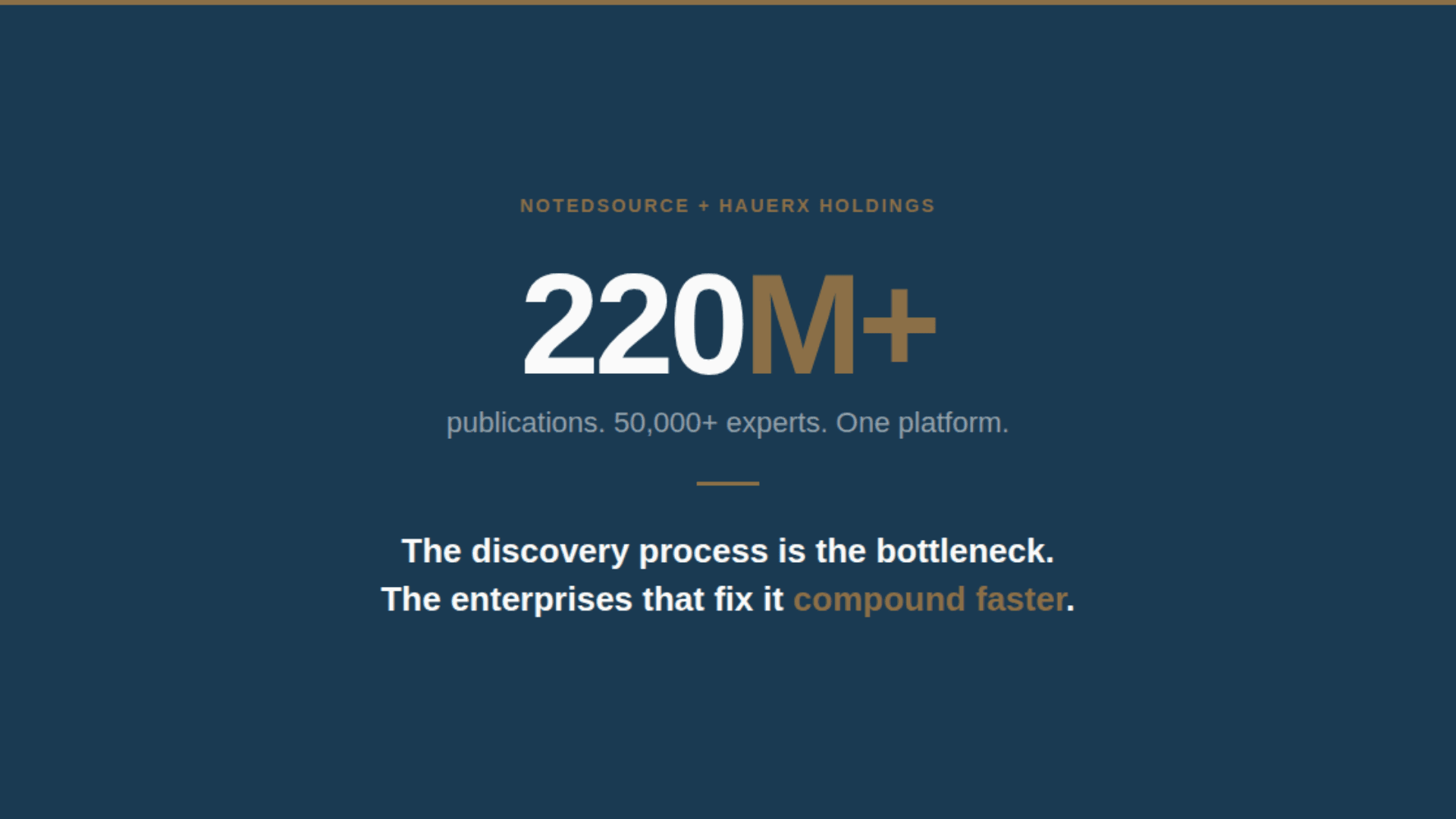
They have research questions that could unlock new product lines, improve formulations, reduce costs, or open entirely new categories. What they do not have is a fast, reliable way to find the external expert, startup, or research partner who can help them answer those questions. The discovery process is the bottleneck. And it's costing them more than most of them realize.
The Innovation Lifecycle Has Compressed. The Discovery Process Has Not.
Product development timelines have shortened dramatically over the last five years. AI is accelerating formulation, simulation, and testing. Consumer signals move faster. Competitive windows are narrower. The enterprises that win are the ones that can move from question to answer to market faster than the cycle used to allow.
But here's the disconnect. While the rest of the innovation process has gotten faster, the way most enterprises find and engage external expertise has barely changed in twenty years.
The typical process still looks like this: someone on the R&D team identifies a knowledge gap. They email their network. They ask a colleague who they used last time. Maybe they call a consulting firm or submit a request to procurement. Weeks pass. The options that come back are limited to whoever happens to be in someone's contact list or whoever the preferred vendor has on their bench.
This isn't a technology problem. It's an access problem. The world's best expertise on any given topic exists somewhere, in a university lab, at a startup, inside a contract research organization, or with an independent researcher who published the defining work in the field. The challenge is that enterprise teams have no efficient way to find that person, vet their credentials, protect the IP, and get the engagement started without burning weeks or months on logistics.
And that timeline is no longer acceptable when the rest of the business is moving at AI speed.
The Hidden Cost of a Small Network
Most enterprise R&D teams operate within a surprisingly small circle of external partners. They work with the same universities, the same consultants, the same CROs they have used for years. Not because those partners are always the best fit for the question at hand, but because finding someone new is too slow and too risky.
The cost of this is invisible but compounding.
When you default to the same network, you get incremental thinking. You get the same frameworks applied to new problems. You miss the researcher three time zones away who solved a version of your problem two years ago. You miss the startup that developed exactly the material or process you need. You miss the cross-disciplinary insight that turns a product improvement into a category breakthrough.
The companies I see pulling ahead in innovation are not necessarily spending more on R&D. They are accessing a wider, deeper pool of external expertise and doing it faster than their competitors. They are treating external discovery as a core capability, not an afterthought.
Why This Matters on the Commercial Side
The conversation about open innovation and external partnerships tends to focus on the research side. That makes sense. But there's a direct commercial cost to slow discovery that rarely gets quantified.
Every month an R&D team spends searching for the right expert is a month of delayed time to market. Every project that defaults to an adequate partner instead of the best partner produces an adequate outcome instead of a differentiated one. Every knowledge gap that goes unaddressed because the team could not find the right resource is a product that launches weaker than it should, or does not launch at all.
For companies in regulated industries like pharma, chemicals, and food and beverage, this is especially acute. The compliance requirements around external partnerships are real: IP protection, NDAs, vetting, contracting. When those processes are fragmented across legal, procurement, and the research team, the friction compounds. A partnership that should take days to initiate takes months.
The enterprises I see winning are the ones that have figured out how to make external discovery as fast and structured as their internal R&D processes. They've built the infrastructure to find the right expertise, protect the IP, and start the work, all without the months of overhead that kills momentum.
Introducing NotedSource to the HauerX Portfolio
This is why I am excited to announce that NotedSource is joining the HauerX Holdings portfolio.
NotedSource is an AI-enhanced platform built for enterprise research and innovation teams that need to find external expertise, access research insights, and manage the full lifecycle of external partnerships in one system. Instead of relying on personal networks and fragmented processes, R&D teams get AI-powered research tools, a global network of over 50,000 vetted experts, and built-in infrastructure for contracts, IP protection, and payments.
The platform has three core capabilities that work together. Research Compass AI surfaces insights from over 220 million peer-reviewed publications, patents, and data sources, giving teams cited, research-backed answers without hours of manual literature review. The Expertise and Solutions Finder identifies the right external partners, from individual researchers to startups to contract research organizations, fast, verified, and project-ready. And the IP and Project Development hub handles contracts, payments, and collaboration with tools built for compliance, quality, and speed.
Think of it as the operating system for external innovation. The same way enterprises have structured their internal R&D workflows, NotedSource brings structure, speed, and scale to the external side of the equation, the side that has been running on email, personal networks, and manual processes for far too long.
The results speak for themselves. Enterprise research and innovation leaders at Reckitt, Nike, Mars, Diageo, General Mills, Johnson and Johnson, Schneider Electric, and Danone are already using the platform. Teams are compressing discovery timelines from weeks and months to days, reducing costs by 60 to 85 percent versus traditional approaches, and accessing expertise they never would have found through their existing networks.
Why This Fits the HauerX Thesis
At HauerX, we back companies that help enterprises compress growth timelines. Not tools that sit on a shelf. Not platforms that require a six-month implementation before they deliver value. Companies that plug into existing workflows and produce measurable impact fast.
NotedSource fits this thesis precisely. An R&D team can run a Research Compass query and have cited, publication-backed insights in minutes instead of weeks. They can identify and engage a vetted external expert in days instead of months. And they can manage the entire partnership, from NDA to payment, in one system instead of across five.
The thing that is often missed in the open innovation conversation is that the bottleneck is not a lack of great research or great researchers. The bottleneck is the infrastructure connecting enterprise teams to the right expertise at the right time. NotedSource eliminates that bottleneck. When you give R&D teams a fast, reliable way to access the world's best expertise, you do not just speed up one project. You accelerate the entire innovation pipeline, and that advantage compounds.
For enterprises running multiple research initiatives across multiple business units, across CPG, chemicals, life sciences, advanced manufacturing, and beyond, NotedSource is the infrastructure layer that has been missing from the external side of innovation.
The Opportunity Ahead
Every large enterprise with an R&D function faces the same discovery challenge. Hundreds of research questions, a small and static partner network, and a process that was designed for a world where product cycles measured in years, not months. AI is compressing those cycles further every quarter. The knowledge that exists in the world's universities, labs, and startups has never been more accessible in theory and more difficult to reach in practice.
The enterprises that build the infrastructure to discover and engage external expertise at the speed their innovation programs demand will not just move faster. They will compound faster, because every external insight they access feeds the next initiative, and the next product, and the next market.
NotedSource has already earned the trust of some of the most demanding research organizations in the world. The platform is proven, the market is massive, and the timing is right. I'm looking forward to helping them scale.
Learn more about NotedSource on our portfolio page, or reach out to me directly at jason@hauerx.com.