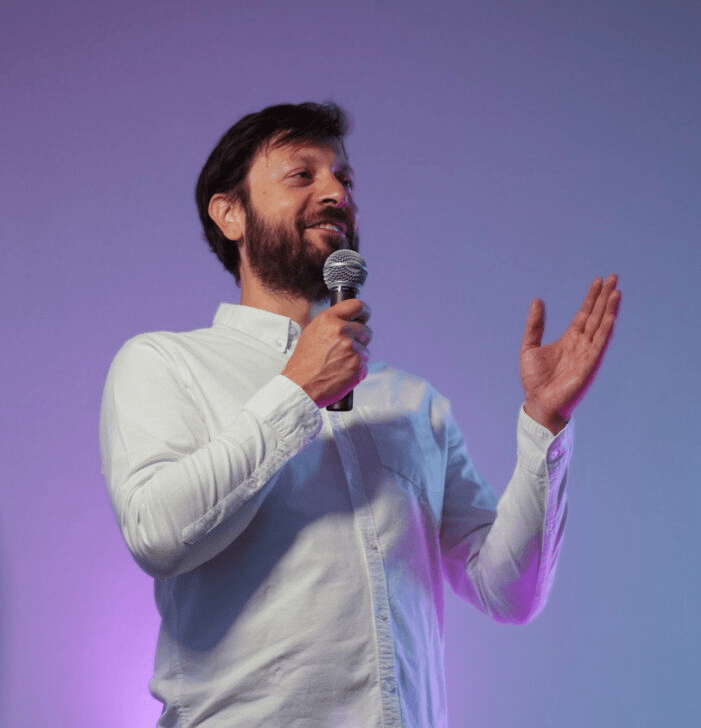
Chicago has always been a builder's city. That was the premise of Build the System, 1871's Emerging Tech Innovation Summit at Hyde Park Labs, the production-focused sequel to the Chicago Accord Policy Summit the day before. The brief for the room was blunt: move the conversation from policy to production. No hype. No hedging. Founders who are shipping, enterprise leaders deploying into production, and the investors backing both.
The session I keep coming back to was the fireside chat between Betsy Ziegler, CEO of 1871, and Scott Holcomb, Deloitte's US Trustworthy AI Leader. Holcomb sits where most of us only get to peek: inside the rooms of Fortune 500 companies that are trying, and mostly struggling, to turn AI into something that hits a P&L. Twenty-odd minutes later he had delivered the clearest field guide I've heard this year for two audiences at once. The leader trying to transform a large organization. And the founder or solutions provider trying to sell into one.
Here's the overarching summary, organized the way I would actually use it.
The thesis: a skill isn't a company
Holcomb opened on a line he had written: you can’t just be a skill anymore. His warning was about dependence on a capability a model provider could add to its own product. A useful feature is a starting point. The harder question is what customers depend on you to understand or deliver that remains valuable as the tools improve.
He was candid about how that felt from the inside. When the ChatGPT moment landed about three and a half years ago, Deloitte genuinely wondered whether the consulting model would be disaggregated within six months. You can laugh about it now. It didn't feel funny then. The lesson he pulled from the other side of that fear is the spine of everything below: better technology isn't a differentiator, because the technology is coming for free.
The durable ground: three pillars nobody wants to do
Ask Holcomb where the real, defensible opportunity sits and he points to three unglamorous places. He's direct that none of them are exciting, which is precisely why they're still open.
Business process. Agents don't work without process. He sees enterprise after enterprise that can't document how work actually gets done. The real process is "ask Mary," or "ask Bob." Drop an agent into that and it fails. The opportunity is upstream: help companies document and fix the process before anyone deploys an agentic solution on top of it.
Data. Most products demo beautifully on a curated, thin slice of data and then break in the wild, because enterprise data is dirty and scattered across systems that don't agree with each other. Your product has to work in that mess, or you have to sell the fix for it. Data governance is the least sexy phrase in the building, and nothing built on top of it works without it.
Governance. This is where deals quietly die. Products get stuck in security review and procurement. Show up without your certifications and the table stakes in place, and you're disqualified before the conversation starts. It's the reason I've put real weight on the governance layer inside my own portfolio. AlignAI was built for exactly this moment, turning AI governance from the thing that stalls a deployment into the thing that clears it. This is the gap between a pilot that dies in legal review and one that ships.
These three pillars are also his answer to the five-year question Ziegler posed: what will separate the companies that adopted AI from the ones that were transformed by it. The transformers will redesign their business processes to be AI-first, which is genuinely a different exercise than bolting AI onto a process built for people. The fundamentals aren't interesting and they erode fast, the same way the ERP and process transformation wave did twenty years ago. You still have to get them right.
Moats that aren't technology
If tech isn't the moat, what is? Holcomb's list is short and it travels well.
Industry expertise. A lot of founders are brilliant engineers with no enterprise scar tissue. Domain depth, built into the product, is a moat a frontier model doesn't casually replicate.
Outcomes over features. "Outcome, outcome, outcome," as he put it. You're solving a problem or driving a result, not shipping cool capability.
Then there's the pitch. Holcomb gets pitched constantly, and most pitches fail the same test: he can't tell what problem they solve. His rule is unforgiving and correct. Under two minutes, crystal clear on what you do and what outcome you drive. If the room can't repeat it back, you don't have a pitch, you have a demo.
Why the frontier labs are building services arms
Ziegler raised the growing role of services and implementation alongside AI products. Holcomb’s read was that adoption and integration remain difficult. A capable model does not, on its own, make an enterprise workflow work.
The implementation work is substantial when agents have to cross systems with different data and controls. My takeaway was practical: founders need to show how a product fits the customer’s actual environment, and leaders need to fund the work required to make it useful.
How will he judge whether they're succeeding? Not by the next product announcement. By the one question he puts to his CFO clients: how are you driving impact around this. Top line or bottom line. Everything else is fingers and toes.
The impact test: singles beat the grand slam
The most useful reframe of the session was about where to aim. Everyone crowds the upper-right corner of the two-by-two, hunting the 25 to 30 percent transformation. Meanwhile the agentic boom has quietly reopened a deep well of legacy AI value. One of his clients automated invoice processing with plain machine learning. Boring. It's also taking real cost out of accounts payable right now. String together enough one and two percent gains and the total dwarfs the grand slam you never landed. You don't have to solve the hardest problem to drive impact.
There's a second half to that conversation worth naming, because the impact lens almost always defaults to efficiency: cost taken out, time saved, heads reduced. The more durable prize is the top-line question Holcomb keeps putting to CFOs, value created rather than value protected. It's the ground Board of Innovation works, helping enterprises use AI to build new offerings and open new growth, not only to trim the cost of the old ones. Efficiency keeps you in the game. Value beyond efficiency is how you change it.
The hidden variable: change management
Holcomb said his respect for change management has grown exponentially in the generative and agentic era, which isn't where most technologists expect to land. People don't like to change. They're set in their ways, and he sees it inside his own firm as clearly as at any client. The product implication is direct: the easier you plug into how people already work, the more impact you'll drive. Adoption is a design problem, not an afterthought. It's the principle behind how I think about Nichefire. Marketing and growth teams don't want another system to learn, they want sharper signal inside the work they already do. Predictive cultural intelligence lands precisely because it meets those teams in their existing process and hands them a differentiated read on culture, rather than asking them to change how they operate to get it.
Right-fit the use case before you build
A theme he kept returning to: teams apply probabilistic solutions to problems that demand deterministic answers, often because someone handed down a mandate or an OKR to "use AI." That's backwards. First decide what you're solving for, and whether the use case is even the right candidate for a probabilistic system. Reasoning models can pull a probabilistic output closer to deterministic, but that doesn't remove the next obligation, which is model risk management: testing for accuracy and bias proactively, before production. Let a system go live and then chase its errors afterward, and you're in a very expensive place that needs advanced data scientists who, sometimes, can't tell you why it broke either.
The architecture question
I asked Holcomb the question my own portfolio lives inside. Several of my HauerX companies, FifthRow and Nichefire among them, have moved from clean SaaS surfaces into the harder territory of data and MCP calls inside an enterprise process. Assuming a startup is differentiated and tied to an outcome, how should it think about fitting into the enterprise architecture and how it gets consumed.
He called tech architecture the most overlooked part of the strategy. ERP isn't dead, and it isn't getting ripped out, partly for sunk-cost reasons and partly for human ones: nobody who green-lit a nine-figure ERP program is tearing it out five years later. So the winning move is to arrive with a proactive point of view on exactly where you fit. How you work with the ERP, the SaaS systems, the data and API platforms. Who you partner with and who you compete against. Do that, and you make it easy for the buyer to answer the only question that matters to them: where do we plug you in.
For the leader: sequence it
When an audience member asked how a company with no AI exposure should sequence internal adoption and product development, Holcomb didn't flinch: put an AI strategy together before you build or buy anything. He knows it sounds like the consultant talking. He's also watched clients incinerate enormous sums by skipping it. He's an engineer who loves to build, and even he says have a plan first. The strategy can be eight pages. What it can't be is absent. Most of what gets built doesn't serve the corporate strategy at all, it's a shiny object someone wanted to make. Your AI strategy exists to serve your corporate strategy. Go slow to go fast. Or, in the line from the room that stuck with me, the most underrated skill in management is problem definition.
The talent problem nobody's solved
The theme he hears behind closed doors that the public isn't really discussing yet: the talent pipeline. He built a fourteen-page deck with Claude on his drive home over a holiday weekend, a B-minus, the work an analyst used to do. So what happens to the analyst. Entry-level work can look like busywork, but it's how people learn business process and strategy and earn the judgment to lead. Take away the entry point and you have a gap with no bridge. No tadpoles, no frogs. He was honest that he doesn't have the answer, and neither does anyone else. It's the open question sitting under every adoption curve.
Two scorecards to take with you
If you lead an enterprise:
- Write the AI strategy before you build or buy. Make it serve the corporate strategy, not the other way around.
- Spend on the unglamorous fundamentals. Document your processes, clean your data, stand up governance. They erode fast and everything sits on top of them.
- Measure impact on the P&L, not activity. Chatbot usage isn't transformation.
- Hunt the singles. Legacy machine learning on a boring process often beats the moonshot.
- Pull legal and compliance in early. They're the throttle on scale, so make them partners.
- Protect the bottom rung. Decide now how your next generation will learn once the entry-level work is automated.
If you sell into the enterprise:
- Build a moat that isn't the model. Industry depth and an owned outcome, not better tech.
- Work in the dirt. Prove your product survives messy, multi-system, real-world data, or sell the fix for it.
- Bring your certifications to the first meeting. Security and procurement readiness is table stakes, not a phase two.
- Pitch the outcome in under two minutes. If the buyer can't repeat what problem you solve, rewrite it.
- Plug into the architecture they already own. Arrive with a point of view on ERP, SaaS, data, and APIs, and on who you partner with versus compete against.
- Reduce the change you require. The closer you sit to how people already work, the faster you get adopted.
- Right-fit the use case. Don't sell a probabilistic system into a deterministic problem, and bring your model risk testing with you.
The builder's city gets the last word
The summit's framing was that AI, blockchain, and quantum have stopped being ideas to track and become systems to build, deploy, and scale. Holcomb's entire message rhymes with that. The edge in 2026 isn't the model. The model is a commodity that gets better and cheaper while you sleep. The edge is the boring, durable work underneath it: process, data, governance, outcomes, and the discipline to define the problem before you spend a dollar solving it.
Asked what he wants to celebrate at the end of 2026, he didn't pick a metric. He picked running six miles three times a week again, once his Achilles finally heals from too many years on Chicago concrete. Fitting, for a man whose entire thesis is that the fundamentals are what carry you the distance.
From the portfolio
Board of Innovation helps enterprise leaders redesign the business around what AI now makes possible, then move from a promising experiment to an operating model that can scale.
What part of your AI advantage would still matter if the model became free tomorrow?