
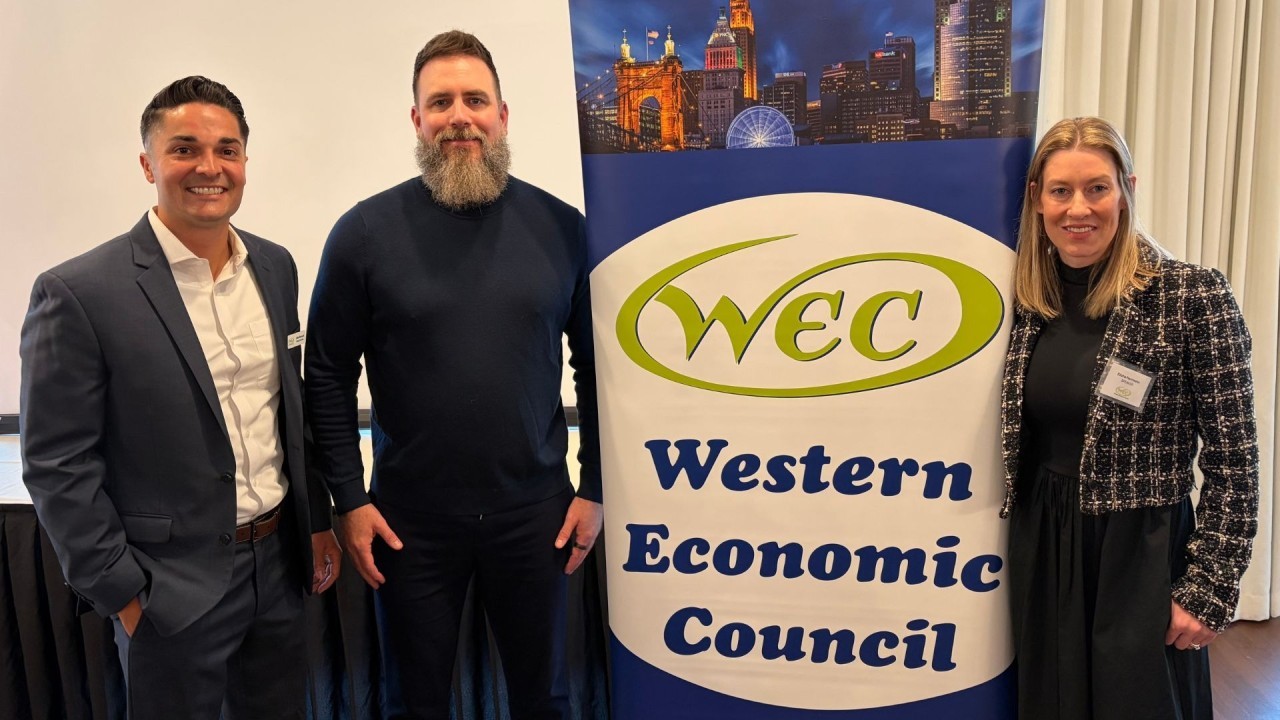
I joined Elisha Herrmann from Amazon Web Services on stage at the Western Economic Council breakfast to talk about AI for business, government, and education.
We kept it practical. Real examples of where AI is already saving time, cutting costs, and opening up opportunities for small and mid-sized organizations. Because that's what matters - not innovation theater, but measurable business outcomes.
Here's what we covered, and more importantly, what you can actually implement starting today.
The Reality Check: AI Isn't New, It's Just Accessible Now
Elisha made a critical point that often gets lost in the hype: AI has been around for decades. You've been using it every time you open Spotify, use GPS, or unlock your phone. The difference now? It's cheap and accessible.
Think about it like this: Remember when a quality TV cost thousands? Now you can grab a 70-inch screen for $200 on Black Friday. That's what's happening with AI - the cost of technology has plummeted, making capabilities that once required massive infrastructure investments available to any business.
Three Ways to Apply AI (Starting Today)
I shared a framework for thinking about AI adoption that cuts through the confusion:
1. Personal Efficiency
Start here. Your team can apply AI to everyday tasks - email, presentations, analysis, research. Same way we adopted Word, Excel, and PowerPoint, except this is exponentially more powerful.
Example: One attendee mentioned prospecting companies in specific cities. Basic move. But you can take it further - ask AI to analyze the specific challenges those CEOs face based on their industry, company size, and market conditions. Now you're walking into conversations with strategic insights, not just a sales pitch.
2. Business Process Automation
This is where ROI gets serious. One of my portfolio companies is using AI to automate their entire quote-to-proposal process, flowing directly into their ERP and execution. They're 70% more efficient on a process that happens a significant amount of the time. Not a massive investment. Industry-defining impact and massive ROI.
3. Customer Experience Enhancement and/or DIsruption
Look at what WPP is doing - the massive ad agency that's been losing billions in market cap is now creating AI-powered automated access for enterprise clients and SMB. That's a signal to the entire industry about where things are headed.
The Tools You Should Actually Be Using
Elisha and I both emphasized the same starting point: ChatGPT, Claude, and similar models. But here's what separates beginners from advanced users:
Upload files for context: Don't just ask questions in a vacuum. Give it your data, your documents, your specific situation.
Get specific with prompts: "You're the top marketer in the world. I'm building a financial services practice. Benchmark best-in-class growth strategies from across the country, analyze them, and give me a specific roadmap I can implement."
Iterate and interrogate: When it gives you an answer, ask it to validate, cite sources, show its work. AI can hallucinate - you need to verify.
For presentations, I use Gamma. For deep financial analysis/modeling and writing, Claude has been exceptional lately. The point isn't which specific tool - it's developing that curiosity mindset, have a willingness to experiment, and pivot to the best tools and models available.
The Real Risks (And They're Not What You Think)
Someone asked about the risks of AI. Elisha hit two critical points:
Data Privacy: With paid versions of most tools, you can opt out of data sharing. But you have to understand how your data is used. Most people don't read those terms - but you should, especially in a business context.
The Risk of Not Using It: Here's the harder truth - someone using AI has a better skillset than you. They have better context. They're more efficient. The risk isn't just competitive disadvantage; it's relevance.
But the risk I see most often? Getting bad or incomplete information and trusting it blindly. You have to interrogate AI outputs. Use the most current models (Claude Sonnet 4.5, ChatGPT-5.1). Ask it to validate its answers. Think critically. AI + human expertise = 70% productivity gains. AI alone without human judgment = garbage.
Why Most AI Initiatives Fail (And How to Avoid That)
MIT recently found that 95% of AI initiatives don't deliver positive ROI within six months. Why? Leaders who aren't fluent in AI are picking the wrong use cases. Projects disconnected from business priorities. Science fair experiments that never impact revenue.
Here's how to avoid that trap:
Start with leadership fluency: Your executive team needs to use ChatGPT, Claude, and other tools regularly. You can't lead what you don't understand.
Crawl before you run: The San Antonio Spurs saved thousands of hours using basic ChatGPT for personal productivity before moving to custom GPTs.
Connect to actual business outcomes: Don't automate for automation's sake. Identify bottlenecks that directly impact revenue, margin, or customer satisfaction.
The Human + AI Advantage
One question that came up: Will AI replace jobs?
Elisha's answer was direct: "Jobs will change. Some will go away. But you still need humans in the loop." She gave the example of Amazon's internal tools creating documents - the output was completely wrong until a human validated links, checked accuracy, and applied judgment.
This isn't about replacement. It's about augmentation. A radiologist using AI is better than one without it. A CFO using AI to automate regulatory reporting frees up strategic capacity. A sales team using AI for personalization closes more deals.
The winners won't be companies that eliminate roles - they'll be companies that make their people 70% more productive while growing more efficiently.
What Ohio Is Doing (And Why It Matters)
One thing that came through clearly: Ohio is not sleeping on AI.
University of Cincinnati has created an AI lab through Josette Rieff. Ohio State is committed to AI fluency for every student (led by President Ted Carter, the original Top Gun Maverick). The Cincinnati AI Catalyst is ensuring our region stays competitive across healthcare, education, and business. The Interalliance is bringing AI education to high school students across Greater Cincinnati.
The data center coming to Hamilton? Jobs, economic growth, infrastructure investment. But also energy costs that get redistributed across all of us. Not all data centers are equal - Amazon's committed to zero water waste, for example. These trade-offs matter.
My Challenge to You
Here's what I told the room, and what I'll tell you: To be successful with AI, you have to be curious. You have to try things. You have to be willing to look dumb, fall on your face, and keep going.
Most of you spent years becoming the smartest person in the room. Now success requires something different - a beginner's mindset, rapid experimentation, and the humility to learn something completely new.
Think about it like a gym membership. If you're paying $100-200 monthly to stay physically fit, shouldn't you invest the same in staying intellectually competitive? ChatGPT Pro. Claude. Gamma. These are investments in your relevance.
The gap is widening every day between those who use AI and those who don't. Between companies automating processes and those stuck in manual workflows. Between leaders who understand this technology and those who treat it like a distant threat.
Start today. Use it. Break it. Learn from it. Apply it to real business problems.
Because compounding beats campaigns - and the compounding effect of AI fluency starts now.
Big thanks to John Bovard and the Western Economic Council for creating space for this conversation, and to Elisha Herrmann for bringing the perspective on what AWS is seeing across enterprises.
Jason Hauer is CEO and Founder of HauerX Holdings, a portfolio company that backs and builds AI-native companies focused on business growth. Based in Cincinnati, HauerX's portfolio includes Board of Innovation, FifthRow, Nichefire, 3D Color, and others serving Fortune 500 to SMB clients across CPG, retail, and B2B sectors. Jason previously founded and exited The Garage Group, an Inc. 500 innovation consultancy. His mission: make AI-native growth the standard for every business, moving companies from pilot purgatory to revenue with a "receipts not rhetoric" approach.


