
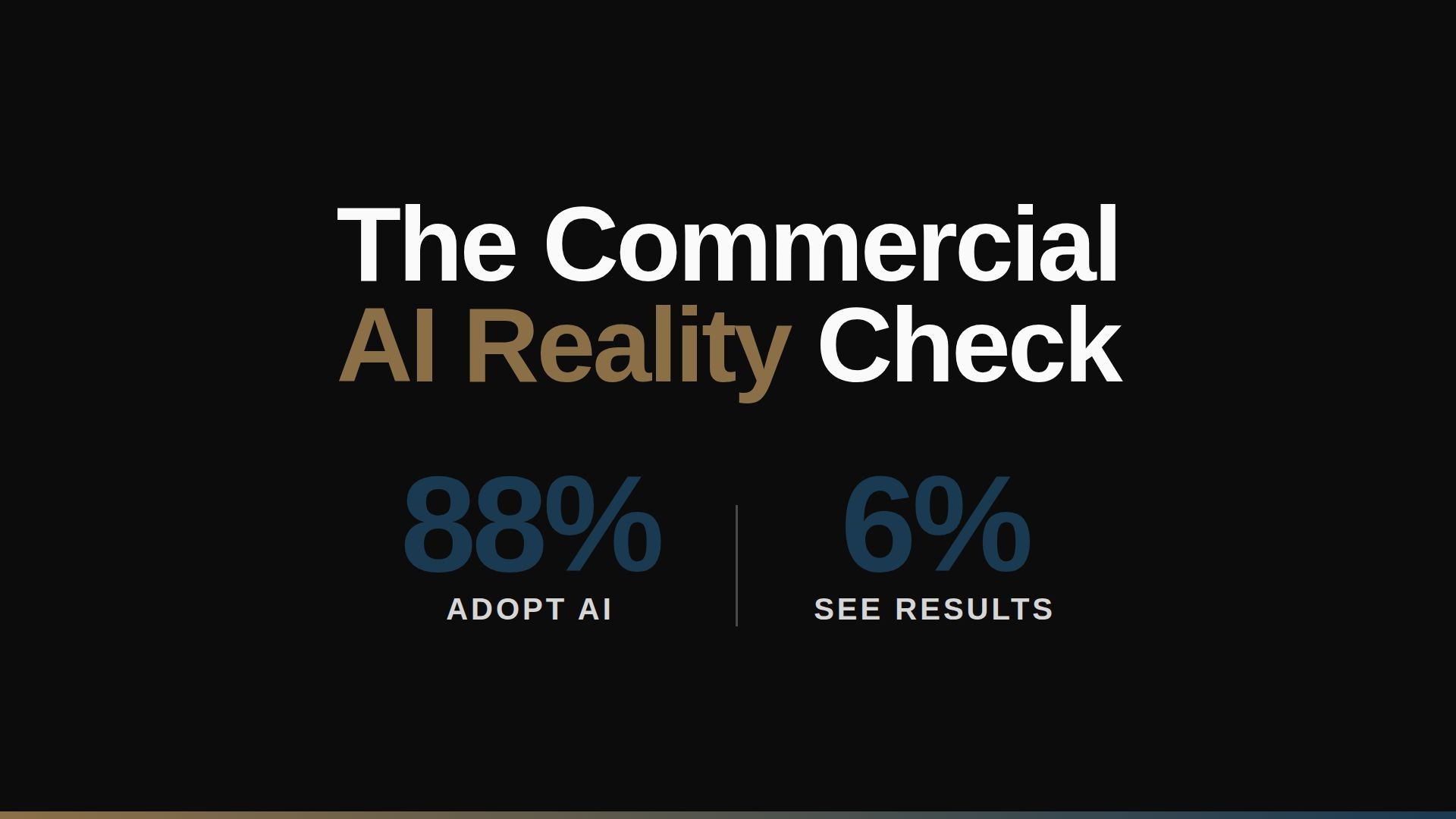
Here's a number that should make every commercial leader uncomfortable: 88% of enterprises now use AI in at least one business function. Only 6% are generating meaningful business impact.
That's not a technology problem. That's an execution problem. And it's creating the most significant competitive gap I've seen in two decades of building and backing growth companies.
According to McKinsey's 2025 State of AI survey, we've reached near-ubiquitous adoption. The question is no longer whether your organization uses AI. The question is whether you're in the 6% transforming your commercial engine or everyone else generating noise without signal.
The receipts are in. And they tell a very different story than the hype cycle suggests.
The Uncomfortable Truth About Where We Stand
Let's start with what the data actually shows.
Bain's Commercial Excellence Survey of 1,263 B2B executives found that more than 90% have scaled at least one AI use case in commercial functions. That sounds like progress. Until you learn that roughly 25% of those pilots fail outright. The RAND Corporation found 80% of AI projects never reach production, exactly twice the failure rate of non-AI IT projects.
Here's what makes this worse: S&P Global Market Intelligence reports that 42% of companies abandoned most AI initiatives in 2025. That's up from 17% the prior year. We're not getting better at this. We're getting worse.
The productivity gains for those who succeed are substantial. Sales representatives using AI are 3.7x more likely to meet quota according to Gartner. ZoomInfo's 2025 research found GTM professionals save 11-12 hours per week while achieving 47% productivity gains. IBM research indicates top performers achieve 10.3x returns on AI investment.
But Deloitte's 2025 analysis finds satisfactory ROI typically takes 2-4 years. That's significantly longer than the 7-12 month payback most technology investments deliver. This is not a patient capital environment. And too many leaders are betting on AI without understanding what actually drives returns.
What the Winners Are Actually Doing
The gap between AI rhetoric and measurable outcomes narrows considerably when you examine specific implementations with documented results, whether you're selling to enterprises or consumers.
On the B2B side, Paycor achieved a 141% increase in deal wins after implementing revenue intelligence. Unity saw 29.9% higher win rates and 209% increase in average sales price. Automox achieved 88% increase in closed-won deals through AI-powered account-based marketing, with more than half of wins traced directly to the platform.
Consumer brands are seeing equally dramatic results. Nutella used AI to generate 7 million unique jar designs for a limited edition campaign in Italy. All 7 million sold out in one month, averaging 2.7 jars per second. Nike's AI-generated "Never Done Evolving" campaign featuring two versions of Serena Williams generated over 100 million views, breaking the company's previous records. Coca-Cola's "Create Real Magic" platform was adopted by over 80 markets worldwide, with consumer artwork featured on digital billboards in Times Square and Piccadilly Circus.
In CPG product development, Nestle's AI-powered concept generator has produced 1,300 products, cutting development time from three months to three weeks. Mondelez created 70 SKUs using their AI product development tool, producing new products two to five times faster than traditional methods. Unilever's digital twins for brands like Dove and Vaseline made image production twice as fast and half as expensive.
These are receipts, not rhetoric. Named companies. Quantified outcomes. Timeframes attached. But here's what most coverage of commercial AI misses: the winners aren't winning because they picked better tools. They're winning because they redesigned how work gets done.
The Real Differentiator: Workflow Redesign, Not Tool Selection
BCG's 2025 research categorizes enterprises into three tiers: 5% are "future-built", generating material value at scale, 35% are "scaling" with emerging returns, and 60% remain laggards, seeing minimal value despite substantial investment.
McKinsey found that high performers are three times more likely to have fundamentally redesigned workflows rather than simply adding AI to existing processes. As Bain's 2025 Technology Report observes: applying AI to existing processes often results in only small productivity gains because new bottlenecks emerge. Without process redesign, companies end up automating inefficiencies instead of removing them.
Read that again. Most organizations are using AI to automate their inefficiencies faster.
The speed differential between AI-native approaches and legacy methods is staggering. Board of Innovation's work with Chiesi, a global pharmaceutical company, illustrates this: their autonomous AI innovation engine accelerated ideation by 115x, cutting concept development time from five days to one hour. What started as a pilot now shapes portfolio strategy and R&D investment decisions across the organization.
FifthRow achieved an 87% success rate for concept validation based on real market data. Compare that to the 30% success rate they saw during 15 years of traditional consulting before launching their AI-native platform. Their Venture Building App now helps Fortune 500 companies discover, test, and develop new ventures 100x faster and 10x cheaper than traditional approaches. That's not incremental improvement. That's a different category of performance.
Why Cultural Intelligence Became a Leading Indicator
One of the most underappreciated shifts in commercial AI is happening in market sensing. The companies pulling ahead aren't just responding to trends faster. They're seeing them before competitors know they exist.
Nichefire, a predictive cultural intelligence platform in our portfolio, recently demonstrated this capability in partnership with HUCKLE. Their AI analyzed 180,000+ social conversations and identified an emerging consumer trend projected to surge 53% over the next 18 months.
The trend they spotted: "Affluent Protein Calculators," educated, high-income families with 3-5 kids who are redefining what "premium" means. An audience where 97% have children, 58% earn $75K+, yet 79% are actively seeking bargains. Traditional demographic models failed to predict this consumer paradox.
This is what AI-native commercial intelligence looks like. Not faster reporting on what happened. Predictive insight into what's about to happen.
Nichefire now works with Walmart, Kraft Heinz, Nestle, and Perfetti Van Melle. They've helped customers uncover over $100 million in new growth and innovation opportunities. In one case shared at the 2024 Observe Summit, Nestle credited Nichefire's predictive insights with spotting the GLP-1 medication trend months ahead of competitors. That early signal enabled Nestle to rapidly develop and launch Vital Pursuit, a frozen meal line designed specifically for consumers using medications like Ozempic. Nestle said missing this insight would have meant significant lost revenue and reduced market share.
The lesson here isn't about any single platform. It's about the structural advantage that accrues to organizations who can see cultural shifts 12-18 months ahead of competitors. That advantage compounds.
The Three Gaps Holding Most Organizations Back
If the path forward is clear, why do so few companies reach it? Three interconnected gaps reinforce each other.
The Data Gap. Gartner reports 63% of organizations lack the right data management practices for AI. You cannot build AI-native workflows on fragmented, siloed, or dirty data. Yet most commercial leaders treat data infrastructure as IT's problem rather than a strategic priority. The companies in the 6% operate on a single enterprise-wide data model. Only 4% of laggards do.
PepsiCo's Chief Data & Analytics Officer Athina Kanioura put it directly: "If we hadn't done all those changes and the moves, it would now be impossible for us to do agentic AI." Their CEO noted that as recently as 2019, the company's data wasn't structured to empower employees. By 2024, that foundational work enabled a "much more aggressive" AI strategy.
The Talent Gap. McKinsey's CxO survey found 46% point to talent skill gaps as the top reason for slow AI adoption. But here's what's interesting: BCG found employee concerns increase alongside usage. Greater familiarity breeds greater anxiety. And leadership anxiety exceeds frontline concerns. 43% of leaders versus 36% of frontline workers worry about losing positions. The people responsible for driving transformation are often the most threatened by it.
HubSpot CEO Yamini Rangan frames the challenge directly: "AI has to go from just being neat to being necessary, to being in the flow of everyday work in order to have the promised transformative benefits." Most organizations are still in the "neat" phase, experimenting without embedding. That's a talent and leadership problem, not a technology problem.
The Ambition Gap. This is the one nobody talks about. Most AI initiatives are scoped for efficiency gains, not business model transformation. They're designed to do existing things slightly faster rather than enable entirely new capabilities.
When Board of Innovation helped Chiesi achieve 115x faster ideation, they weren't optimizing an existing process. They were building a new capability that changed how the company makes portfolio decisions. When FifthRow delivers 87% validation success versus 30%, they're not improving consulting. They're replacing it with something structurally different. When Nutella generated 7 million unique designs that sold out in a month, they weren't running a traditional marketing campaign. They turned every jar into a collectible. The 6% aren't just executing better. They're playing a different game entirely.
What 2026 Demands from Commercial Leaders
The next 12 months will separate the companies that figured this out from those that didn't.
Gartner predicts 40% of enterprise applications will include task-specific AI agents by end of 2026. McKinsey estimates agentic AI will power 60%+ of increased value from AI deployments in marketing and sales. Forrester predicts one in five B2B sellers will face AI-powered buyer agents delivering counteroffers.
Read that last one again. Your buyers will have AI agents negotiating with your sellers. The implications for pricing, sales skills, and competitive positioning are profound.
Consumer brands face their own inflection point. According to NVIDIA's State of AI in Retail and CPG survey, 87% of respondents said AI had a positive impact on increasing annual revenue. 94% said AI helped reduce operational costs. And 97% said spending on AI would increase in the next fiscal year. The gap between AI-native consumer brands and traditional players is widening fast.
Enterprise AI spending hit $37 billion in 2025, up 3.2x from the prior year. Yet only 1% of companies have reached AI maturity according to Menlo Ventures. That means 99% of companies are still figuring this out. The question is whether you'll be in the 6% who figure it out in time or everyone else who invested without transforming.
The Questions That Actually Matter
Forget the technology roadmap for a moment. The strategic questions that will determine your outcome are simpler and harder:
Are you redesigning workflows or layering tools? If your AI initiative isn't changing how work gets done, it won't change your results. The 6% rewire processes. Everyone else adds features.
Can you see what's coming, or only what's happened? The shift from reactive analytics to predictive intelligence represents a structural advantage. If your commercial team is still responding to trends rather than anticipating them, you're already behind.
Is AI neat or necessary in your organization? This is Yamini Rangan's test. If your teams are still experimenting on the side rather than embedding AI into daily workflows, you're stuck in the "neat" phase. The 6% have made it necessary.
What's your 87% vs 30% story? FifthRow improved concept validation from 30% to 87% by going AI-native. Nestle cut product development from three months to three weeks. What process in your commercial engine could see that kind of transformation? If you can't identify one, you're not thinking big enough.
Are you measuring capabilities or just efficiency? Board of Innovation delivered 115x faster ideation. Nichefire identifies trends 18 months early. Nutella turned 7 million jars into collectibles. These aren't efficiency metrics. They're capability metrics. The difference matters.
The Path Forward
The evidence is clear. Commercial AI works, but not the way most organizations are implementing it.
The 6% succeeding share common characteristics: enterprise-wide data architecture, focus on fewer high-impact use cases, 70% of effort directed toward people and process transformation rather than technology selection, and visible C-suite ownership throughout.
The failures share equally consistent patterns: treating AI as a technology problem, underinvesting in data quality, deploying in isolated pockets rather than redesigning processes, and optimizing for efficiency rather than capability.
The strategic question is not whether to adopt AI. That decision has already been made by market dynamics. The question is whether you're building for the 6% or settling for the status quo.
Compounding beats campaigns. Receipts beat rhetoric. And the leaders who understand this will define the next decade of enterprise growth.
The window is open. But it won't stay open forever.
Jason Hauer is CEO and Founder of HauerX Holdings, a portfolio company that backs and builds AI-native companies focused on enterprise growth. Board of Innovation, Nichefire, and FifthRow are HauerX Holdings portfolio companies. He publishes the Tuesday Growth Brief newsletter and writes at Serial Growth Lab.
Subscribe to the Tuesday Growth Brief: hauerx.com/subscribe


