
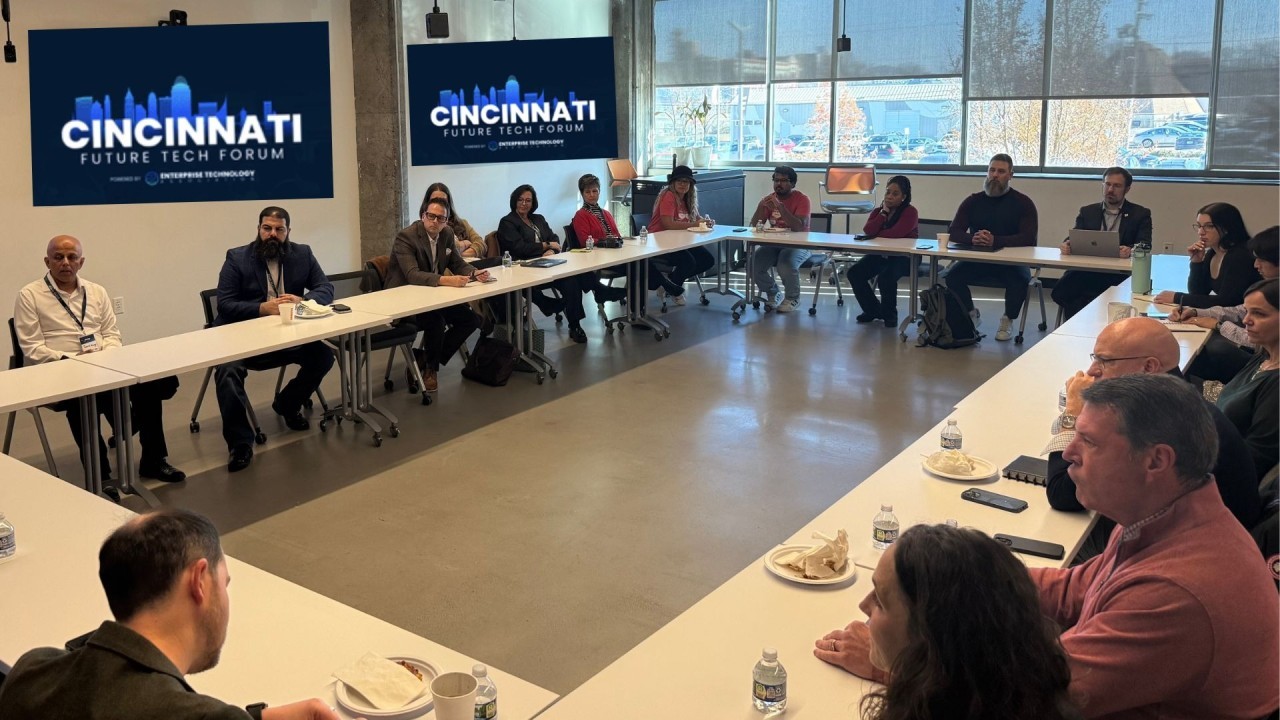
Early December 2025, I sat in a room at UC's 1819 Innovation Hub for the AI Ready Ohio Roundtable at ETA's Future Tech Forum. Leaders from JobsOhio, AWS, Fifth Third Bank, Cintas, Miami University, the University of Cincinnati, and a dozen other organizations gathered around one question: how do we make Ohio a national leader in AI readiness?
Ohio has an AI readiness problem. Columbus ranks around 27th nationally. Toledo? 171st. Cincinnati sits somewhere in the uncomfortable middle. The rankings come from research firms analyzing LinkedIn credentials, published patents, investment dollars, and workforce certifications. By those measures, we're losing.
But here's what the rankings miss: some of the most important AI work in the world is happening right here, and almost nobody knows about it.
The Secret We're Not Telling
Dr. Kelly Cohen, Director of UC's AI Bio Lab and Digital Futures, shared a story that stopped the room. Thales, the $20 billion French aerospace and defense company, chose Cincinnati as their global hub for certified AI in safety-critical systems. When you buy a plane ticket today and see that little insurance disclaimer, it exists because AI systems for takeoff and landing aren't yet certified as safe. UC built the certification framework that's changing that.
Thales leadership is flying in from Paris for a ribbon-cutting in April. They're expanding their Cincinnati team by 3.5x. The chief AI officer for Thales North America did his bachelor's, master's, and PhD at UC. His entire team developing this technology? UC grads.
This is world-class, category-defining work. And when asked about it, Dr. Cohen said: "It's a secret. Nobody wants to talk about it."
That has to change.
The Opportunity Is Multi-Front
The room spent time discussing certifications, credentials, and training programs. All important. Technical talent development matters. Research output matters. But the conversation kept circling back to a parallel issue that's equally critical.
The companies winning with AI aren't just technically superior. They have more curious leaders.
I've seen this pattern across every enterprise I work with. The organizations succeeding it with AI have C-suites and boards who use the technology daily, who demand experimentation, who tolerate the messy middle before ROI shows up. The organizations stuck in pilot purgatory have leaders who treat AI as someone else's job.
Wall Street tells the same story. AI is in the plumbing, not the water running through the pipes. Companies are investing in chips and data lakes, but business applications aren't materializing. Why? Leadership isn't fluent enough to know what to deploy or curious enough to push through the messy middle before ROI shows up.
The path forward requires taking ground on both fronts. Continue building technical capability and research credibility. And accelerate strategic AI fluency at the leadership level. When executives understand what's possible, budgets follow. Strategy follows. Talent follows. One without the other leaves value on the table.
What's Being Built
JobsOhio, through the Enterprise Technology Association, is launching AI Ready Ohio. The goal is straightforward: make Ohio's regions national leaders in AI readiness and real-world AI impact.
The work is already underway:
Get people certified. Not just through AWS or Microsoft, but through accessible, lightweight programs that meet people where they are. The model was tested in Toledo, where thousands got certified at a major event. Now it scales.
Enable businesses to implement. Training is one thing. Matching trained talent to companies ready to hire is another. The co-op infrastructure at UC and the adult learning pathways being built could become a regional advantage if we connect the dots.
Tell the story. Every organization in this region has an AI story worth telling. The problem is we're not telling them. When researchers compile their rankings, Cincinnati doesn't show up because our wins aren't visible.
The Universities Are Already Leading
Ohio's major research universities aren't waiting for permission.
Ohio State President Ted Carter, the former Navy admiral who inspired the mission in Top Gun: Maverick, has committed to making every OSU student AI-fluent by 2029. That's not a pilot program. That's institutional transformation at scale.
University of Cincinnati's Vice President and Chief Digital Officer Bharath Prabhakaran drew an even sharper line: "Our goal is to transform UC from 'AI-fluent' to truly 'AI-ready.'" The distinction matters. Fluency is awareness. Ready means infrastructure, governance, and deployment. UC built BearcatGPT on their own Azure environment, deployed AI Socratic Tutors across math and statistics courses, and embedded AI into credential certification and invoice processing. Not slides about AI. Actual AI in production.
Two Ohio schools, 107 miles apart on I-71, showing the country what institutional AI commitment looks like. The enterprise sector should be paying attention.
Where You Come In
This isn't a spectator sport. The window to establish Ohio as a leader in AI readiness and impact is open. Whether we claim it depends on who steps up.
If you're a corporate leader: Your curiosity is the bottleneck. Block time to learn. Use the tools yourself. Stop delegating AI strategy to IT. The ROI shows up after you commit, not before. And inspire your teams to create the next case studies that put Cincinnati and Ohio on the map. Every breakthrough that stays internal is a missed opportunity to build regional momentum.
If you run a startup: Go vertical. Horizontal AI plays require coastal capital and runway. The Midwest advantage is industry depth. Pair technical talent with people who understand the process and the customer. That's where defensible value gets built.
If you're in workforce development: Connect with the AI Ready Ohio effort. The certification programs need trainers. The events need programming. The ecosystem needs people who can translate between technical capability and business application.
If you're a student: Seek out the AI work happening on your campus. The Lindner Honors student in that room made a point that landed: Gen Z is entering the workforce and the market. You have leverage. Use it to push for more collaboration, more hands-on experience, more access to the people building real solutions.
If you have a story: Tell it. Dr. Cohen shouldn't be the only one talking about world-leading work. If your company is using AI in ways that create value, that's a regional asset. Make it visible.
The Window
The rankings measure what's visible. Right now, Cincinnati's AI work is almost invisible. That's a choice we can change.
This isn't about catching up. It's about leading. Ohio has the industry diversity, the university talent pipeline, and the enterprise customer base to become a model for how regions build AI readiness and drive real impact. Not through hype cycles. Through applied work that creates jobs, solves problems, and compounds over time.
The companies are here. The universities are here. The talent pipeline is here. The only question is whether we'll organize around this moment or let it pass.
I know which side I'm on.
If you want to get involved with AI Ready Ohio or connect your organization to this effort, reach out to the Enterprise Technology Association at zack@joineta.org.


