Last week, I joined Rehgan Bleile, co-founder and CEO of AlignAI, to discuss turning AI ideas into commercial impact. With 2027 budgets taking shape, I've been thinking about how we build the capability to choose, scope and deliver that work repeatedly across the business.
I've talked with several leaders recently who've had a few high-profile AI initiatives go to market successfully. Now they're starting to enable their business units to do more. But everyone has their own approach to scoping an idea, if they have one at all, and they're missing a consistent way to work through what has to be true for these initiatives to succeed.
That matters when we're deciding where to invest next. AI adoption is already widespread, but leaders still need to establish how that activity connects to business results. The surveys below show how much of that work remains.
THE GAP, IN TWO SURVEYS
BCG, July 22, 2026. McKinsey, August 25, 2026.
To make that connection, we've got to be clear about what we're trying to solve, which decisions will change, how that will improve the business and what it will actually cost to make it work. Those are the questions a team needs to work through when it scopes an initiative.
I saw this often in my innovation and growth consulting days. Some of the smartest leaders are used to running an existing business and knowing how the system works. Once you start talking about changing the business model, reaching new customers or diversifying revenue, you're learning again. You have to become more entrepreneurial, bring people together from different parts of the company and be willing to say you don't have all the answers. That can feel uncomfortable, especially when you're being asked to make an investment decision.
Rehgan talked about how to build that scoping skill. You have to understand how the business works and which levers you can pull, along with what the technology can and can't do. She talked about teaching business people more about AI and technical people more about the business, then getting them in the room together. Risk needs to be part of that conversation too, while there's still time to shape what we're going to build.
That conversation gives the people delivering the initiative a clearer understanding of what it needs to accomplish. It can also show us that the costs don't work or that the idea is less valuable than other things we could be doing.
We should be finding that out early enough to change where we put our time and money.
Once we're making those decisions across business units, we need a consistent way to compare the work. At a top-ten U.S. bank working with AlignAI, there were more than 130 AI initiatives running across 13 lines of business. The governance team found four lists of initiatives, each with a different count. Before leaders could compare the opportunities, they needed a clear picture of what was actually in the portfolio.
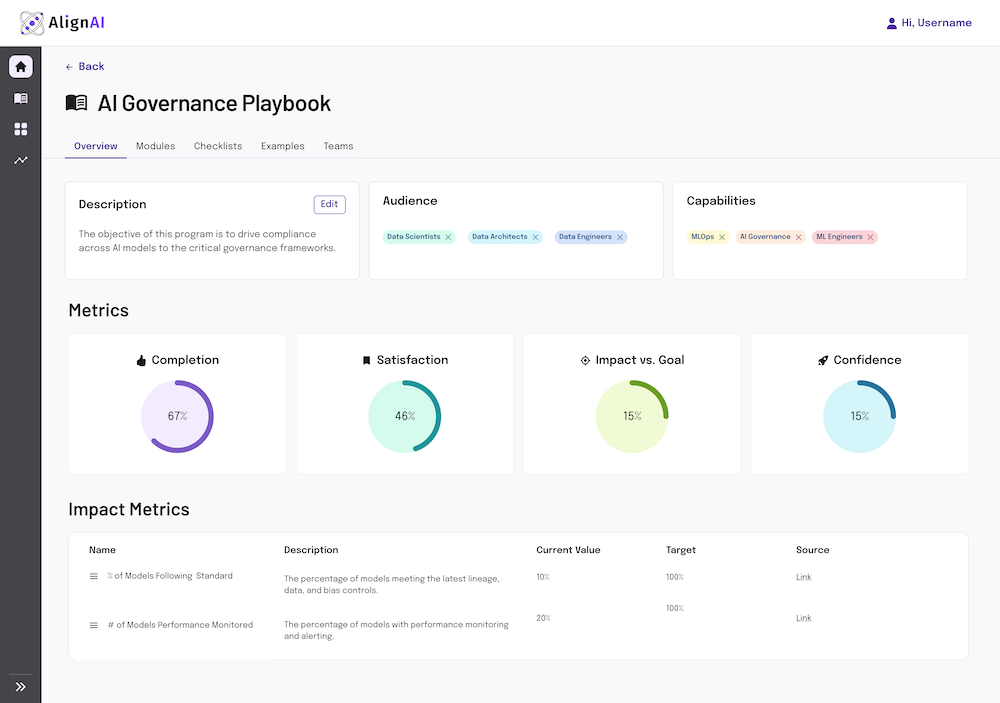
The bank brought intake, risk review and portfolio tracking into AlignAI, with one intake form and a live portfolio view for the CDAO, CIO and CFO. AlignAI keeps the business case and the operating details in one blueprint, so the people shaping, reviewing and delivering an initiative work from the same context. Leaders can see where work is moving and what's held up, alongside the case for investing in it.
That shared context matters as we look across efficiency, innovation and growth initiatives for 2027. We need to be able to compare what each one could contribute, decide where our time and money should go, and learn from what happens when the work gets into use.
What to do this week.
Pick the AI initiative in next year's plan you're most excited about and ask the team for one page: the decision it changes, the P&L line it moves, what it will cost to run, and what would make you stop. Then ask for the same page on the rest of the portfolio.
Where the team struggles to write that page, get the business, technical and risk people in the room together. Work through what you still need to understand before the budget locks.
Then look at the whole list. Are these the initiatives that will help build the company you want to be running in 2030?
From the portfolio
AlignAI brings the business case, review process and portfolio view together. Its enterprise work includes Huntington Bank, Bread Financial, Geisinger, Worthington Steel, and Belron.
If this is something you're working through, reply and tell me about it. I'll connect you with Rehgan.
Can you see what your AI portfolio is made of?