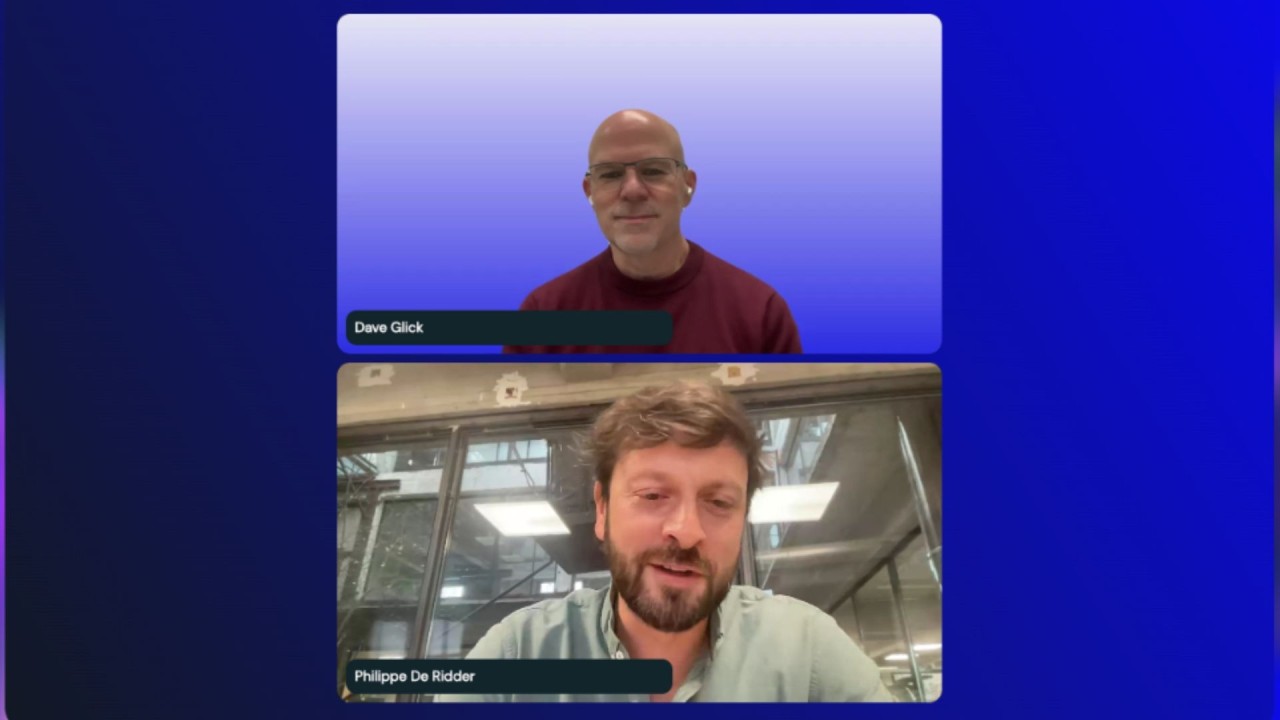
At the 2025 Autonomous Summit, Dave Glick, SVP of Enterprise Business Services at Walmart, sat down with Philippe De Ridder, CEO of Board of Innovation, for a conversation that should be required listening for every enterprise leader.
Not because Dave shared a polished corporate narrative. Because he shared what actually happens when the world's largest retailer stops planning and starts building.
The takeaway that caught everyone off guard: "It's not overhyped. It's underhyped."
The Myth Worth Retiring
When Philippe asked Dave to name one myth about enterprise AI he'd like to retire, the answer was immediate: "The myth is that it's hard."
That's a bold claim from someone operating at Walmart's scale. But here's what backs it up:
In the conversation, Dave described business users learning to build small agents for their own work. That is a useful form of participation. It does not make every user a software engineer or remove the need for technical review.
Dave's philosophy is deceptively simple: "If you move the customer and the engineer closer together, good things will happen. When the customer and the engineer are the same person, they're going to get what they know they wanted."
The "Nano Agent" Strategy
Walmart has a prioritization problem every enterprise faces. Individual teams want tools built for their specific needs. Engineering can't prioritize a solution that only helps one team when enterprise-wide projects are on the table.
The old answer: "No, that's not big enough."
The new answer: "Let me show you how to do it yourself."
This is the Nano Agent philosophy. Rather than centralizing all AI development, Walmart empowered business users to build their own solutions. Not with complex platforms. With direct access to AI coding tools.
The idea was to put a practical building capability closer to the people who understood a problem, while keeping a different standard for systems entering production.
This isn't about replacing engineers. It's about eliminating the bottleneck between knowing what you need and getting it built.
Governance That Doesn't Stop Progress
Here's where most enterprises get stuck. They see the speed at which AI is moving and immediately reach for the brakes. New policies. New committees. New approval chains.
Walmart took a different approach.
Dave described working with compliance colleagues to apply existing data and privacy controls to the activity under discussion. That is an account of Walmart’s approach, not a conclusion that every organization’s current policies are sufficient for every AI use.
Dave shared a story that crystallized the approach. The Chief Auditor, the person responsible for internal oversight, told Dave he had downloaded AI tools and written some Python over the weekend. But he couldn't get an API key to access production systems.
Dave's response: "Good. The system is working as it should."
The distinction was between room to experiment and permission to access production systems. Both need clear boundaries.
The Vibe Coding Session
Perhaps the most telling moment came when Dave described a spontaneous session with his engineers. They were in town for a week. Dinner plans were on the table.
Instead, Dave proposed an alternative: "How about we do vibe coding instead?"
From 6pm to midnight, the team built an agent builder. The goal was audacious: create a tool where you could input a standard operating procedure and have it automatically generate an agent to execute that process.
They got a working UI. They built their first agent. In one evening.
One of Dave's team members called him afterward with a realization that stopped him in his tracks: "This is not overhyped. This is underhyped. I haven't written code in 10 years, and I built a SaaS product in one weekend."
What This Means for Enterprise Leaders
What interested me was the connection between learning and governance. Building something specific exposed questions that a general strategy discussion could not resolve.
The difference shows up in momentum. When you actually build, you hit real barriers. Working with compliance, legal, InfoSec. Running through those barriers rather than theorizing about them.
Three principles emerge from Walmart's approach:
First, democratize the capability. When business users can build their own solutions, engineering becomes a force multiplier rather than a bottleneck. The people closest to problems become the people solving them.
Second, start with your actual governance. Work with the responsible teams to identify which existing controls apply and where an AI use creates a gap. Make those decisions part of the experiment.
Third, just start. Every theoretical planning cycle is a cycle not spent learning from actual implementation. The insights Dave's team gained came from doing, not planning to do.
The Speed of Change
When Philippe asked how Dave stays current in a space evolving this fast, the answer was refreshingly practical: podcasts, conversations with practitioners, and most importantly, constant building.
"Every morning we wake up and there's a new model or a new tool," Dave said. "So we have to continue to iterate and continue to dive deep."
This isn't a space where you can delegate learning. Leaders who want to drive AI transformation need to get their hands dirty. Build agents. Try the tools. Discover firsthand what's possible.
What I would take into the next leadership meeting
Dave’s account points to an operating question: how can people close to a problem test a useful idea, with clear ownership of the data, controls and production decision?
That is a more productive starting point than assuming either that AI is too difficult to try or that a prototype is ready to run the business.
Give a team a bounded problem, an appropriate environment and a way to review the result. Then use what it learns to decide the next step.
This article is based on a fireside conversation at the Autonomous Summit, hosted by Board of Innovation. HauerX backs AI-native growth companies building the future of enterprise performance.
Source: AUTONOMOUS 2025, Scaling AI at the World's Largest Retailer
From the portfolio
Board of Innovation helps enterprise leaders redesign the business around what AI now makes possible, then move from a promising experiment to an operating model that can scale.
Trying to give more people room to build with AI while keeping a clear review process? Tell me how the work moves through your company, and we can look at where AlignAI fits.
Are you still centralizing every AI build, or are you giving the people closest to the work a safe way to build?