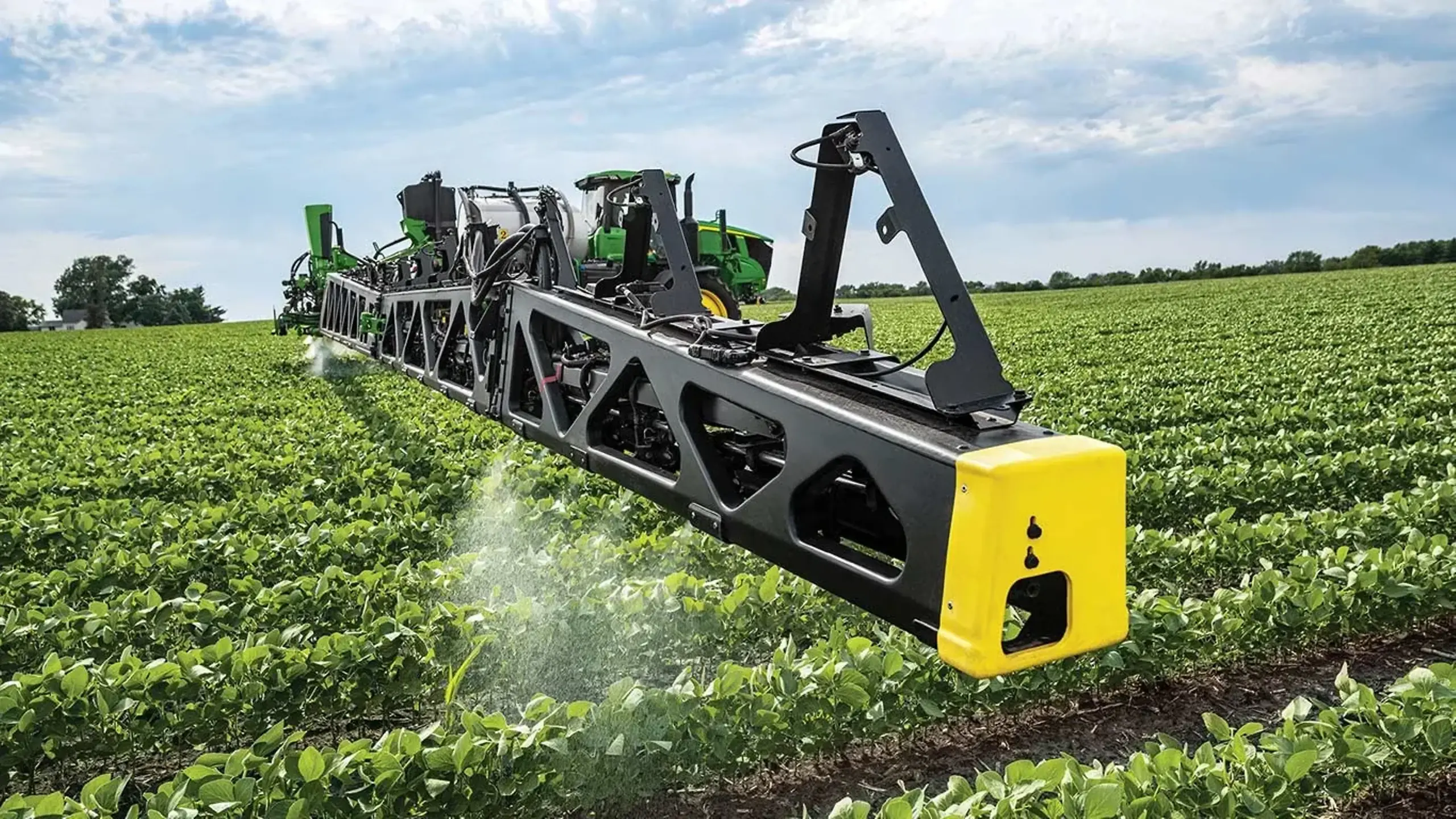
A Deere sprayer moves through a soybean field at working speed. Cameras along the boom distinguish crops from weeds. Individual nozzles fire where treatment is needed and skip the gaps. The grower can review a coverage map and see how much of the field needed spraying.
That machine is the clearest test I've found for which AI bets deserve growth money. See & Spray gives a leadership team something concrete to examine: a costly customer problem, a working solution, and a business with room to improve as the technology develops.
Here's what the sprayer is fighting. Meet Palmer amaranth. It can grow as much as three inches a day, and one female plant can produce hundreds of thousands of seeds. Populations have developed resistance to multiple herbicides. Growers have been dealing with glyphosate-resistant Palmer amaranth for more than twenty years.
Weeds grow unevenly across a field. Broadcasting a herbicide that kills emerged weeds means treating plenty of ground where there isn't a weed to hit. Every unnecessary application costs money. And when growers repeatedly rely on the same herbicide, resistant survivors can produce the next generation.
There are still good reasons to treat an entire field. Residual herbicides work in the soil to control weeds that haven't emerged yet. See & Spray changes the economics of targeting the weeds already there. Growers still need an effective resistance-management plan.
The system puts the targeting inside equipment farmers already use. Dealers help with setup and support. There's a learning curve, but the farmer doesn't have to decide which nozzle should fire at every plant. That work happens while the machine moves.
The demand signal showed up on Deere's August 20 earnings call. Early-order trends suggested factory adoption of See & Spray would nearly double, with the technology on roughly one in three North American Deere sprayers on order. Those are orders pointing into the next season.
The field results help explain the interest. Deere reports that customers reduced non-residual herbicide use by an average of nearly 50% in 2025, saving nearly 31 million gallons of herbicide mix. That's the chemical aimed at emerged weeds. A grower's dollar return depends on the field, the spray program, and the cost of the technology.
Put yourself in that customer's planning meeting. A meaningful share of a recurring input bill can come out, and the grower can check the result against what actually happened in the field. That's a return worth working through acre by acre.
Deere placed an important bet in 2017, when it agreed to buy Blue River Technology for about $305 million. The California startup had begun with machines that thinned lettuce one plant at a time. Bringing that kind of precision into broadacre farming meant solving a much harder problem at working speed.
What made the acquisition interesting was everything Deere could bring around the technology. It already made the sprayers and had dealers working with growers. Over the years that followed, the connected-machine network and Operations Center added a growing body of operational data. By August 2026, Deere reported more than 520 million engaged acres across nearly 1.2 million connected machines.
The camera array could become part of a supported product, with a way into farms already buying Deere equipment. Existing sprayers could also be upgraded where compatible. The startup's invention had a route to customers.
I've spent this year walking leadership teams through a five-question canvas for scoring AI bets. I call it the compounding growth engine. See & Spray gives us a useful case for each question. Run it through:
Does it solve a strategic problem the customer already feels in dollars? The weed problem shows up in a farm's input bill and threatens the crop it needs to sell. Nobody has to manufacture urgency around that.
Does it build on advantages you already hold? Deere could put the technology into its sprayers and work through dealers with established customer relationships. Its digital infrastructure grew alongside the product.
Is the outcome measured in multiples? Using roughly half as much of the targeted herbicide changes the cost of doing the job. The test for a grower is whether those savings still hold up after equipment and usage costs.
Does it remove effort and hide the machinery? Plant-by-plant decisions happen inside the equipment. The value is visible in the work, while the grower gets on with running the field.
Does it have a loop in it? Blue River's product manager describes a deliberate process: collect images across different field conditions, label them, train the models, then test and refine them. A growing image library helps the team improve performance and extend the technology to new crops and regions. That takes engineering work.
The commercial model is developing too. Deere offers See & Spray usage pricing tied to acres left unsprayed. It still has a long-term ambition for recurring revenue to reach 10% of enterprise revenue, although in December 2025 it moved that target beyond 2030.
Question five is where I'd spend the most time with your team. Who collects the evidence after a customer uses the product? Who turns it into an improvement? How does that improvement reach the customer? If nobody owns those steps, the loop is still a drawing.
Deere has shown what that work can produce. Its 2025 improvements included a higher operating speed for See & Spray Premium and changes that made the system easier to run. The product team had something useful to carry back into the next season.
The retention opportunity follows from that work. Keep improving a product that saves the customer money, and you give them a reason to choose it again. That's my read on the business. The order book shows demand; we'll need repeat-use and renewal evidence to judge how strong the hold becomes.
A bet that learns is a bet that compounds, hectare by hectare.
JOHN DEERE · SEE & SPRAY · 2017–2026
Sources: Deere Q3 2026 earnings call, August 20; Deere's 2025 field results; Deere 2025 Business Impact Report; acquisition announcement. Savings vary with conditions.
Further reading: Palmer amaranth and resistance, the product team's account of model development, and Deere's revised recurring-revenue timeline.
What to do this week.
Budget cycles are opening while AI initiatives pile up faster than anyone can track. Start with ten minutes. Pull every AI initiative you're funding or weighing into one list and score each against the engine. One point per honest yes. Use the checklist to challenge the weak ones and spot where a promising bet needs more work.
THE COMPOUNDING GROWTH ENGINE
- Strategic problem. The customer already feels it in dollars. ☐ 1 pt
- Existing advantage. Your data, assets, and relationships do the heavy lifting. ☐ 1 pt
- Outcome in multiples. Value the customer rebuilds around. ☐ 1 pt
- Invisible machinery. Show value, cut effort, hide the AI. ☐ 1 pt
- The loop. Customer use feeds improvement, and improvement earns more use. ☐ 1 pt
Your score: __ / 5. My starting filter: 4–5, a growth bet worth examining; 3, fixable; 1–2, consider whether it belongs in the productivity budget; 0, rethink the case. The score starts the investment discussion. You'll still need to work through the economics.
Then run the earnings call test. Put yourself five years out and picture your CEO talking about this initiative the way Deere's leadership talks about See & Spray. Customers are ordering it because they can see what it does for their operation. The next version gives them another reason to use it.
Sit with that scene for a minute. If it lands flat, the problem may be too small or the improvement too weak to matter across five years. Knowing that before the money goes out is worth the ten minutes.
Take the scored list to your next planning meeting and give your top scorer a dollars-saved ticker: a value counter your customer can understand. It might show money saved, time recovered, or revenue earned. Decide how you'll measure it while you're deciding what to fund.
From the portfolio
Finding the bet that scores five, and building the model that lets it compound, is the work Board of Innovation does with enterprises.
Which growth bet are you deciding whether to fund? Send me a little context, and we can look at what you still need to learn and whether BOI could help.
Deere went after a problem growers were already paying to solve, then kept investing in the product around it. Carry that standard into your next budget cycle.
Rank every AI bet on your desk against the engine. Five years from now, on the earnings call, which one is your CEO proud to name first?